Battle of Cynwit (878): Odda’s West Saxon Victory Over the Vikings
England
The Battle of Cynwit was a West Saxon victory over a Viking force in 878 exact date is unkown. Led by Ealdorman Odda of Devon, the defenders were trapped inside the hillfort of Cynwit while Vikings, traditionally said to be led by Ubba, waited outside. Rather than surrender or remain under siege, Odda’s men launched a surprise attack at dawn and overwhelmed the Viking camp. Ubba was killed, the Viking force was defeated, and the West Saxons captured the Raven Banner. The victory helped protect Wessex during the crisis that also saw king Alfred the Great fighting the wider Viking invasion.
Outcome
West Saxon victory
Commanders
OddaEaldorman of Devon · West Saxons
UbbaViking commander · Vikings
Forces engaged
VikingsAbout 840–1,200
West SaxonsUnknown
Casualties
VikingsAbout 840–1,200 killed
West SaxonsUnknown
Region
South West England
Coordinates
51.159, -3.078
Chronicle
What happened
I
Chapter 1 of 5
Background
Wessex at Its Lowest Point
Early in 878, the kingdom of Wessex was close to collapse.
For years, Viking armies had struck across England. They had taken control of the north and east of the country, divided the central kingdom of Mercia, and left Wessex as the last major independent Anglo-Saxon kingdom in the south.
Then the Viking leader Guthrum launched a surprise winter attack on Chippenham, an important royal centre in Wessex. King Alfred was forced to flee into the marshes of Somerset, in southwest England, where he gathered a small band of supporters. For a moment, it seemed that the Vikings might finish what they had started and conquer Wessex completely.
At the same time, another Viking force crossed the sea from Wales and landed on the coast of what is now Devon in southwest England. According to an Anglo-Saxon Chronicle, it arrived in 23 ships. Its commander is not named in the earliest account, although later tradition identifies him as Ubba, a brother of the famous Viking leaders Ivar and Halfdan.
The Vikings advanced inland and surrounded a West Saxon stronghold called Cynwit.
Nobody can say exactly where Cynwit was. The most likely location is thought to be an old hillfort on the rugged southwest coast of England, above the sea and not far from modern day Lynmouth. Another possible site lies farther east, near the Bristol Channel. What matters for the story is clear enough: it was a fortified hilltop, strong on most sides, with a force of West Saxon defenders trapped inside while Viking ships waited somewhere below on the coast.
The defenders were probably led by Odda, a powerful local West Saxon nobleman and ealdorman of Devon. They had taken refuge inside the fort, but refuge was becoming a prison. The Viking army surrounded them, and the stronghold had no water source immediately within its defences.
It was a small fight in a year full of larger ones.
But while king Alfred was still in hiding and Wessex was fighting to survive, Cynwit mattered.
Asser — Life of King Alfred.
Wikipedia — “Battle of Cynwit.
Æthelweard — Chronicon.
The Anglo-Saxon Chronicle — entries for 878.
A Fortress Under Siege
The Vikings surrounded the fort and waited.
The West Saxons could see the enemy outside, but they could not easily leave. Asser says the defenders had no water inside the stronghold, meaning they could not stay behind their walls indefinitely. The Vikings appear to have expected hunger and thirst to do the work for them.
For the defenders, there were only two choices: surrender, or attack.
They chose attack.
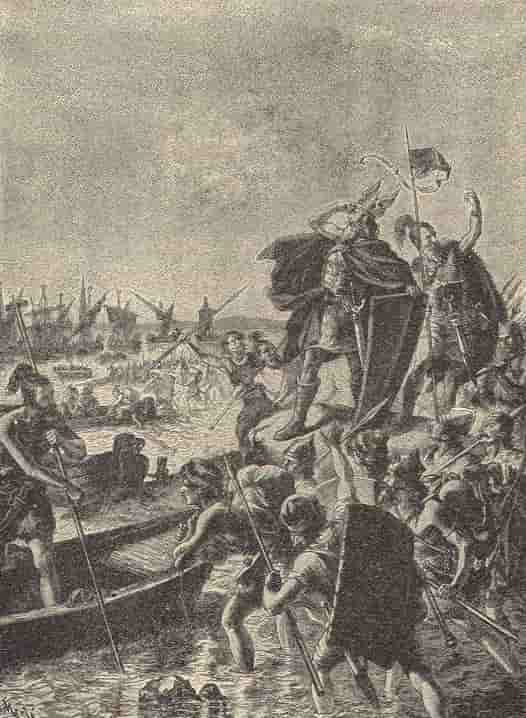
At dawn, the West Saxons suddenly burst out of the fort. The Vikings had expected a siege. Instead, they faced a desperate charge from men who knew that remaining behind the walls meant slow defeat.
The fighting was close and violent. There was no room for a great battle line or careful manoeuvre. The West Saxons had to break through the Viking force before it could recover from the surprise.
They succeeded.
The Viking army was overwhelmed, and its leader was killed. The early sources describe him only as a brother of Ivar and Halfdan; later tradition calls him Ubba. The West Saxons also captured the Viking raven banner, a powerful symbol associated with their enemy.
Asser — Life of King Alfred.
Wikipedia — “Battle of Cynwit.
Æthelweard — Chronicon.
The Anglo-Saxon Chronicle — entries for 878.
The Siege Becomes a Trap
The key turning point was the Viking decision to surround the fortress and wait for the defenders to surrender.
It was a reasonable plan. The West Saxons had little or no water, and the Vikings had them contained. But a siege only works if the trapped force accepts its position. At Cynwit, the defenders turned desperation into surprise.
The Vikings were prepared to watch the fort.
They were not prepared for its defenders to explode out of it at dawn.
The Dawn Attack
The West Saxons attacked when the Vikings were least ready. The early morning assault gave them the advantage of surprise and prevented the Vikings from using the time, space, and mobility that normally made raiders dangerous.
The defenders had been trapped. But once they broke through the Viking line, the besiegers were the ones caught in confusion.
The Death of the Viking Leader
The death of the Viking commander was probably decisive. In a small force fighting at close quarters, leaders mattered enormously. Once the commander was killed, the army’s ability to organize resistance may have collapsed.
The later name attached to him is Ubba, but this should be treated with care. An Anglo-Saxon Chronicle and Asser call him only the brother of Ivar and Halfdan. The identification with Ubba appears in later tradition.
Asser — Life of King Alfred.
Wikipedia — “Battle of Cynwit.
Æthelweard — Chronicon.
The Anglo-Saxon Chronicle — entries for 878.
A Victory at the Edge of Wessex
Cynwit did not end the Viking threat. Guthrum still controlled much of Wessex, and King Alfred was still gathering his army in the Somerset marshes.
But the victory mattered because it destroyed a separate Viking force at the very moment Wessex could least afford another enemy army. It also removed a coastal threat and gave the West Saxons a rare success during one of the darkest moments of Alfred’s reign.
A few months later, Alfred emerged from hiding, gathered the men of Wessex, and defeated Guthrum at the Battle of Edington. The victory at Cynwit was therefore not the final turning point of 878, but it was one of the smaller blows that helped Wessex survive long enough to fight back.
The Raven Banner
The captured Viking banner became part of the story’s legend. It was known as the Raven Banner, likely displaying a raven associated in Norse tradition with Odin and victory in war.
Later sources claimed that the banner had been woven by the daughters of the Viking leader Ragnar Lodbrok and that it carried supernatural power: if it fluttered, the Vikings would win; if it hung still, they would lose. Those details are legend, not certain history. What the early sources do confirm is that the West Saxons captured an important Viking banner after the battle.
Asser — Life of King Alfred.
Wikipedia — “Battle of Cynwit.
Æthelweard — Chronicon.
The Anglo-Saxon Chronicle — entries for 878.
1. A Battle Preserved in Just a Few Lines
Cynwit was important, but the early written accounts are remarkably short. The Anglo-Saxon Chronicle gives the basic result: 23 Viking ships arrived in the southwest, their leader was killed, hundreds of Vikings died, and the Raven banner was captured. Almost everything else the exact place, army sizes, detailed movements, and even the identity of the West Saxon commander had to be reconstructed from later sources and careful guesswork.
4. The Raven Banner Was a Symbol of Command
When the West Saxons captured the Raven banner, they had taken more than a piece of cloth. A war banner showed where a commander and his followers were fighting; it was a visible sign that the force was still organized and still resisting. At Cynwit, the Viking leader was killed and his banner was taken. To the West Saxons, that would have made the victory unmistakable: the Viking army had not simply retreated — it had lost its leader, its symbol, and its ability to fight as a united force. Later stories added that the banner could predict victory, but that part belongs to legend rather than certain history.
The Anglo-Saxon Chronicle — entry for 878.
Asser — Life of King Alfred.
Wikipedia — “Raven Banner.
The Ground
Where it was fought
Test yourself
Quiz
Question 1
Cynwit was the single battle that saved Wessex from Viking conquest in 878.
Question 2
The West Saxon sortie was made at dawn. Which explanation best shows why that timing mattered?
Question 3
Which statement is the most historically responsible way to describe Cynwit’s location?
Question 4
Why could Cynwit matter strategically even though it was much smaller than Alfred’s later victory at Edington?
Explore more
You Might Also Like
Ranked by country match, then era, then how close the battles were in time.