Battle of Kircholm (1605): Chodkiewicz's Hussars Rout the Swedish Army
Latvia
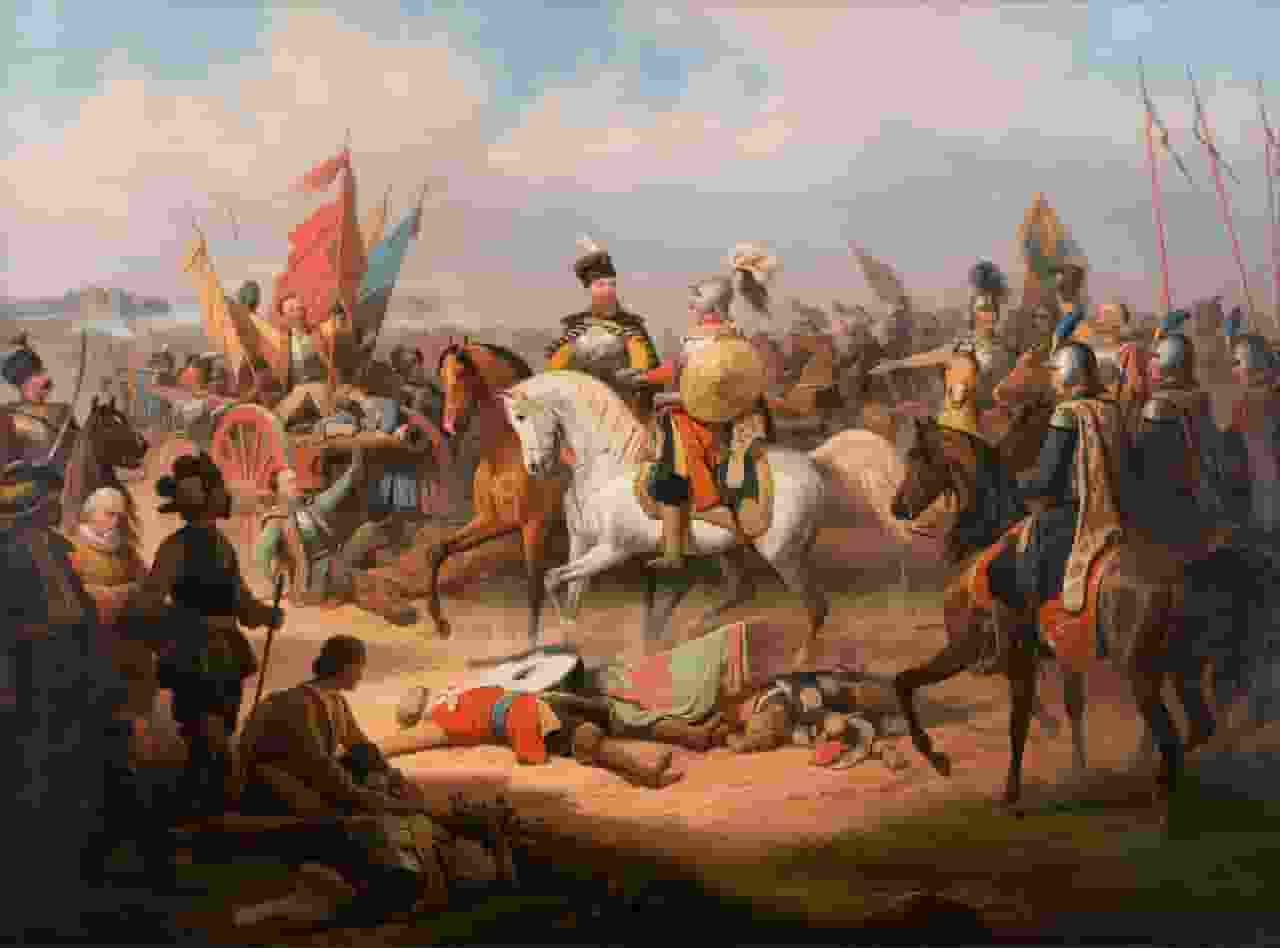
The Battle of Kircholm was a decisive Polish-Lithuanian victory during the Polish-Swedish War. On 27 September 1605, Hetman Jan Karol Chodkiewicz led about 3,600 Polish-Lithuanian troops against a Swedish army of about 10,800 commanded by King Charles IX near Kircholm, now Salaspils in Latvia. The Commonwealth (Polish-Lithuanian) force included about 2,600 cavalry, 1,000 infantry, and 5 guns, while the Swedish army fielded roughly 2,000–2,500 cavalry, 8,300–9,000 infantry, and 11 guns. Chodkiewicz drew the Swedish army forward before ordering his winged hussars to strike its flanks and centre. The Swedish line collapsed, and the retreat became a rout. Sweden lost about 8,000 men killed or captured, while Polish-Lithuanian losses were about 300. Kircholm became one of the most famous victories of the Polish-Lithuanian winged hussars.
Outcome
Polish-Lithuanian victory
Commanders
Jan Karol ChodkiewiczArmy commander · Polish-Lithuanian Commonwealth
Charles IXKing and army commander · Sweden
Forces engaged
Swedish TotalAbout 10,800
Swedish CavalryRoughly 2,000-2,500
Swedish InfantryRoughly 8,300-9,000
Swedish Artillery11 guns
Polish-Lithuanian TotalAbout 3,600
Polish-Lithuanian CavalryAbout 2,600
Polish-Lithuanian InfantryAbout 1,000
Polish-Lithuanian Artillery5 guns
Casualties
Swedish TotalAbout 8,000 killed, captured
Polish-Lithuanian TotalAbout 300
Region
Salaspils
Coordinates
56.849, 24.348
Chronicle
What happened
I
Chapter 1 of 4
Background
A War for Livonia
In 1605, Sweden and the Polish-Lithuanian Commonwealth were fighting for control of Livonia, the territory that now covers much of modern Latvia and Estonia. This was more than a border war. Livonia controlled major ports on the Baltic Sea, trade routes along the Daugava River, and access to the wealthy city of Riga.
The conflict also had a personal edge. Sigismund III Vasa, king of the Polish-Lithuanian Commonwealth, had once been king of Sweden as well. In 1599, he had been removed from the Swedish throne by his uncle, Charles. Charles had then taken control of Sweden and later became King Charles IX. The war in Livonia was therefore a struggle for territory, influence, and dynastic legitimacy.
In the summer of 1605, Charles IX led a large Swedish army into Livonia and threatened Riga, one of the Commonwealth’s most important Baltic cities. The Swedish army had about 10,800 men: roughly 8,300–9,000 infantry, 2,000–2,500 cavalry, and 11 guns.
The force facing it was far smaller. Hetman Jan Karol Chodkiewicz commanded only about 3,600 soldiers: around 2,600 cavalry, 1,000 infantry, and five guns. In raw numbers, the Swedes had nearly three men for every Commonwealth soldier.
The situation looked even worse for Chodkiewicz because the Swedish army had more artillery, which gave it an edge in open battle. His army relied heavily on cavalry especially the famous Polish-Lithuanian winged hussars. They were elite shock troops armed with long lances, sabres, and pistols, trained to charge in disciplined formations and accelerate to tremendous speed only in the final moments before contact.
Chodkiewicz could not afford a straightforward attack against a larger army holding strong ground.
He would have to make Charles IX abandon it.
The Hill Outside Riga
The two armies faced each other near Kircholm, today Salaspils, southeast of Riga. The Swedish army occupied a low rise overlooking the surrounding plain. From there, Charles IX could see the Commonwealth army below and force Chodkiewicz to attack uphill.
For several hours, little happened.
Chodkiewicz sent forward skirmishers and small units, hoping to draw the Swedes down from their position. Charles refused. He had the larger army, more guns, and higher ground. There was no reason for him to move.
Then Chodkiewicz changed the picture.
He ordered part of his force to appear to withdraw. From the Swedish line, it looked as though the smaller Commonwealth army had lost its nerve and was retreating.
Charles IX believed he had the enemy running.
He ordered his army forward.
The Swedish infantry marched down from the hill toward the plain. As they advanced, their neat formations began to stretch apart. The cavalry moved to cover the wings, while the infantry's Pike-and-Shot Blocks formation (tightly packed blocks of pikemen in the middle with musketeers on the sides) in the centre became separated from one another.
That was exactly what Chodkiewicz had been waiting for.
wikipedia - Battle of Kircholm
The Past — The Battle of Kircholm, 1605 Sweden’s Greatest Defeat
Warfare History Network — Incomparable Bravery
Polish History — The Great Victory of the Winged Hussars
Academic study — Battle of Kircholm (Salaspils) in 1605 The Current State of Research.
The Feigned Retreat Ends
The Commonwealth troops stopped withdrawing and turned back toward the advancing Swedes.
Chodkiewicz had placed most of his cavalry on the wings, especially on his left. His infantry held the centre, supported by a small reserve of hussars and a few reiters (pistol-armed cavalrymen) under his direct control.
The Swedish army still had the advantage in numbers, but it no longer had the advantage of position. By leaving the hill, Charles IX had brought his infantry onto open ground, where the Commonwealth cavalry could move freely.
The Commonwealth infantry and artillery opened fire as the Swedes advanced, while the cavalry prepared to strike. this had the Swedes try to close up their formation.
Then the hussars charged.
The Wings Collapse
On the Commonwealth left, the main body of winged hussars attacked the Swedish right wing. The charge hit the Swedish cavalry from the front, while lighter cavalry worked around the side.
The Swedish horsemen broke.
This exposed the flank of the Swedish infantry. Instead of chasing the fleeing cavalry, the hussars turned inward toward the centre, where the Swedish foot soldiers were still trying to hold their position.
On the other side of the battlefield Swedisch cavalry also gave way. Charles IX’s army was now losing control of both wings.
The Swedish infantry remained dangerous. Its soldiers formed blocks designed to support one another with muskets and pikes. But those blocks had become separated when the army advanced down the slope. They could not easily help each other, and they could not quickly turn to face cavalry attacks from multiple directions.
The Centre Is Surrounded
With the Swedish cavalry defeated, the hussars struck the infantry.
The Commonwealth infantry and artillery held the Swedish centre from the front, while cavalry attacked the sides and rear. The Swedish formations tried to resist, but the open plain had become a killing ground. Men were packed into isolated blocks, unable to retreat without exposing themselves to the cavalry.
The battle was decided with astonishing speed. Most accounts place the decisive fighting at roughly 20 to 30 minutes, though the pursuit and scattered resistance continued longer.
Charles IX narrowly escaped. He fled toward the Daugava River and eventually reached the Swedish fleet, leaving much of his army dead, wounded, captured, or scattered across the battlefield.
The Commonwealth had won one of the most dramatic cavalry victories of early modern Europe.
wikipedia - Battle of Kircholm
The Past — The Battle of Kircholm, 1605 Sweden’s Greatest Defeat
Warfare History Network — Incomparable Bravery
Polish History — The Great Victory of the Winged Hussars
Academic study — Battle of Kircholm (Salaspils) in 1605 The Current State of Research.
Charles Leaves the Hill
The first turning point was Charles IX’s decision to advance.
The Swedish army had the safer position. It held higher ground, had more infantry and more artillery . Chodkiewicz could not easily attack it there.
The feigned retreat changed Charles’s calculation. He believed the smaller army was leaving the battlefield. By ordering his troops forward, he gave up the hill and brought his army onto the open plain precisely where Chodkiewicz’s cavalry could be most dangerous.
The Infantry Blocks Separate
The second turning point came as the Swedish army moved downhill.
The Swedish infantry had been arranged in several large blocks, designed to support one another with overlapping musket fire. But the advance stretched these formations apart. Instead of a single connected line, the Swedish centre became separate groups with gaps between them.
Those gaps gave the hussars room to attack. Once the Swedish cavalry was defeated, the infantry blocks could not protect each other from attacks on their flanks and rear.
The Hussars Turn Inward
The final turning point was the decision of the Commonwealth cavalry not to chase the Swedish horsemen after breaking them.
The hussars turned back into the battle and attacked the Swedish infantry. Their charges, combined with pressure from the Commonwealth infantry in front, trapped them from several sides with no easy way out.
The battle was not won because the hussars were simply brave or fast. It was won because Chodkiewicz army struck at the right moment, against an army whose formation had already begun to break apart.
wikipedia - Battle of Kircholm
The Past — The Battle of Kircholm, 1605 Sweden’s Greatest Defeat
Warfare History Network — Incomparable Bravery
Polish History — The Great Victory of the Winged Hussars
Academic study — Battle of Kircholm (Salaspils) in 1605 The Current State of Research.
Sweden’s Army Is Destroyed
The Swedish defeat was catastrophic. Of about 10,800 Swedish troops, roughly 8,000 were killed, wounded, or captured. The Polish-Lithuanian Commonwealth suffered about 300 casualties.
The difference was extraordinary. Chodkiewicz had defeated an army almost three times the size of his own while losing less than one-tenth as many men.
The victory forced Charles IX to abandon the siege of Riga and withdraw toward the Baltic coast. Swedish forces gave up much of their immediate offensive position in Livonia, and the Commonwealth saved one of its most important cities.
A Victory That Could Not Be Used
Kircholm was a tactical masterpiece, but it did not end the war.
The Commonwealth had won the battlefield, but it lacked money to keep its army together. Soldiers were often unpaid, supplies were limited, and the state’s political system made it difficult to raise taxes quickly for a long campaign. Chodkiewicz could not turn the victory into a destruction of Swedish power in Livonia.
Sweden, meanwhile, could replace its losses more easily over time. Charles IX died in 1611, but his son Gustavus Adolphus inherited the war and would later transform Sweden into one of Europe’s leading military powers.
Kircholm stopped the Swedish offensive in 1605.
It did not settle the struggle for the Baltic.
wikipedia - Battle of Kircholm
The Past — The Battle of Kircholm, 1605 Sweden’s Greatest Defeat
Warfare History Network — Incomparable Bravery
Polish History — The Great Victory of the Winged Hussars
Academic study — Battle of Kircholm (Salaspils) in 1605 The Current State of Research.
The Ground
Where it was fought
Explore more
You Might Also Like
Ranked by country match, then era, then how close the battles were in time.