Battle of Neerwinden (1693): The French Victory at Landen Explained
Belgium
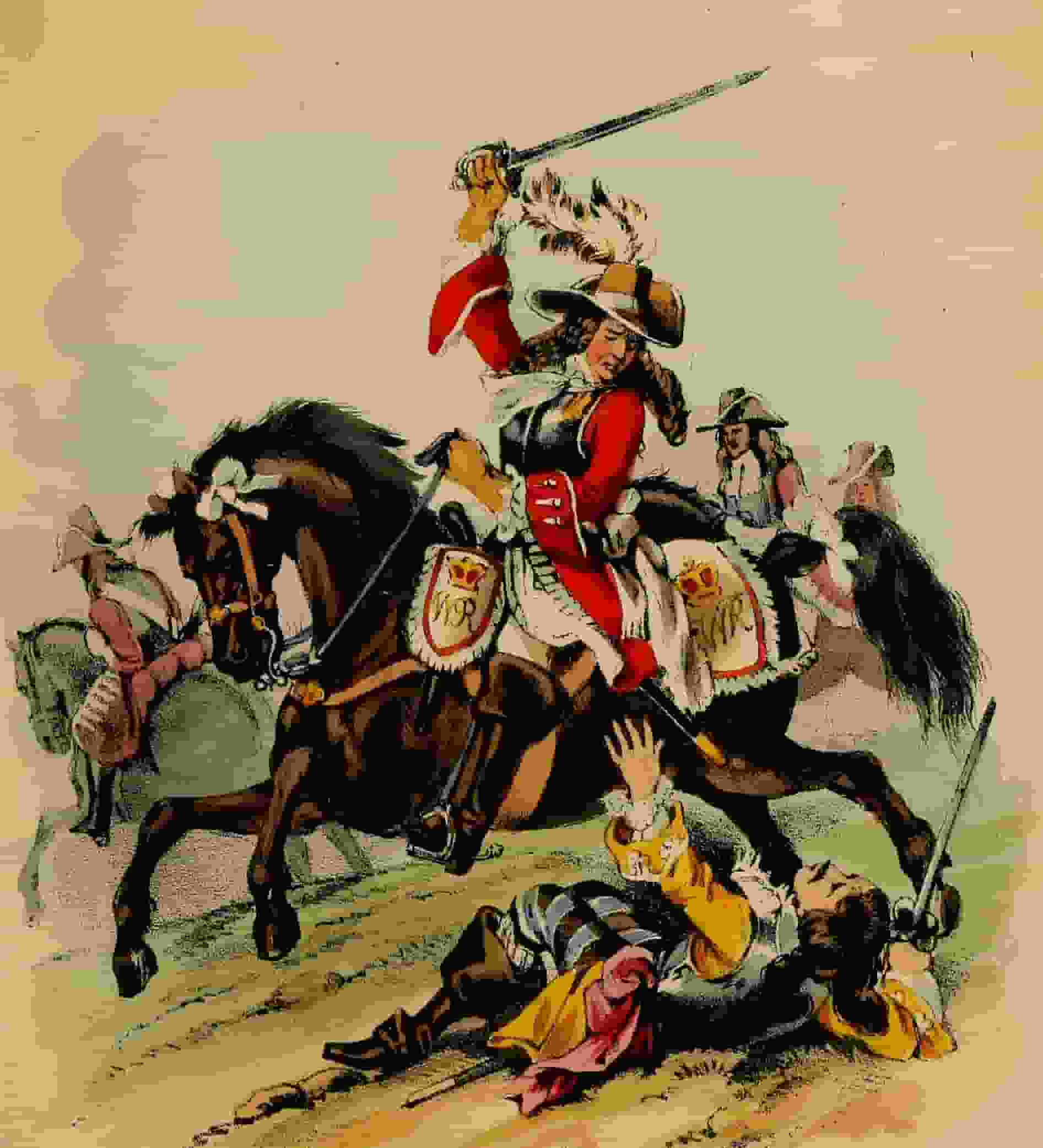
The Battle of Neerwinden (1693) was a French victory during the Nine Years' War, when Marshal Luxembourg's larger army broke through William III's fortified defensive line near the village of Neerwinden. What was Luxembourg's strategy? He pinned the Allied centre and left with supporting attacks while massing the bulk of his infantry and artillery against Neerwinden and Laar on the Allied right, planning to smash a gap in the earthworks and send his waiting cavalry through it. How did William respond? Trapped with the Little Gete River at his back, William fortified the villages along his line overnight with trenches, barricades, and earthworks, holding Neerwinden and Laar at all costs to protect his only line of retreat. What was the outcome? After hours of close-quarters fighting for the fortified villages, the French finally broke the Allied right, forcing William to withdraw his battered army across the river in one of the bloodiest battles of the war.
Outcome
French victory
Commanders
Marshal François-Henri de Montmorency, duc de LuxembourgCommander-in-chief · France
Duc de VilleroySenior commander (centre) · France
Prince de ContiWing commander · France
King William III of England (Stadtholder of the Dutch Republic)Commander-in-chief · Allies
Prince Maximilian II Emanuel of BavariaSenior Allied commander · Allies
Henry Casimir II, Prince of Nassau-DietzDutch field commander · Allies
Forces engaged
Allies50,000–60,000 troops, 80–100 guns
France70,000–80,000 troops, 70 guns
Casualties
Allies12,000–20,000 troops
France12,000–15,000 troops
Region
Flemish Brabant
Coordinates
50.773, 5.035
Chronicle
What happened
I
Chapter 1 of 5
Background
The War Behind the Battle
By the summer of 1693, Europe had been at war with Louis XIV of France for five years. The conflict was known as the Nine Years’ War, or the War of the Grand Alliance, and it had begun as a struggle to contain French expansion under the ambitious Sun King. Against France stood a broad coalition: the Dutch Republic, England, Spain, the Holy Roman Empire, Savoy, Bavaria, Brandenburg, Saxony, and several other German states.
At the centre of the Allied resistance stood William III, King of England and Stadtholder of the Dutch Republic. William had spent much of his life confronting France. In 1672, French armies had nearly overwhelmed the Dutch Republic, and since his seizure of the English throne during the Glorious Revolution of 1688, Louis XIV had supported William’s rival, the exiled James II. For William, the war was not simply about territory. It was about preventing France from becoming so powerful that no European state could stand against it.
The fighting in the Spanish Netherlands — roughly modern Belgium — was especially important. This region formed the invasion route between France and the Dutch Republic, and its fortified towns were the locks and gates of western Europe. French victories at Fleurus in 1690 and Steenkerque in 1692 had strengthened Louis XIV’s position, but neither had destroyed the Grand Alliance or forced it to accept peace.
Louis wanted something more decisive.
The Year of Decision
The French king entered the 1693 campaign determined to improve his position before negotiating. He assembled enormous armies across several fronts and reportedly regarded the year as a campaign of crisis — a chance to break the alliance before France’s enemies could recover.
In Flanders, command fell to François-Henri de Montmorency, Duke of Luxembourg — the famous Marshal Luxembourg, one of Louis XIV’s most talented and aggressive commanders. Luxembourg had already defeated William at Steenkerque, but he now faced a larger problem than winning another battle. He needed to turn victory into something permanent.
His opportunity came in July.
French forces captured Huy on 23 July, threatening the approaches to Liège and placing pressure on William’s communications. William immediately marched to relieve it, but Huy fell before he could arrive. He now had to decide whether to retreat, move west toward the Duke of Württemberg’s detached corps, or remain in the region and protect Liège and Brussels.
Luxembourg helped make the decision for him.
French movements suggested that Liège itself was about to be attacked. William began moving east, hoping to cover the city. But this was exactly what Luxembourg wanted. On 28 July, the French commander suddenly reversed direction and forced his army into a rapid march toward the Allied position. By evening, roughly 80,000 French troops had reached the area around Landen, while William had only about 50,000 effectives immediately available.
William had been caught with his back toward the Little Gete River, a tributary of the larger Gete. Crossing it at night would have been dangerous, especially without enough cavalry to protect the retreat. William chose to stand and fight.
A Defensive Line Built in the Dark
William’s army had little time to prepare. During the night of 28–29 July, the Allied soldiers turned the villages along their position into a connected defensive line.
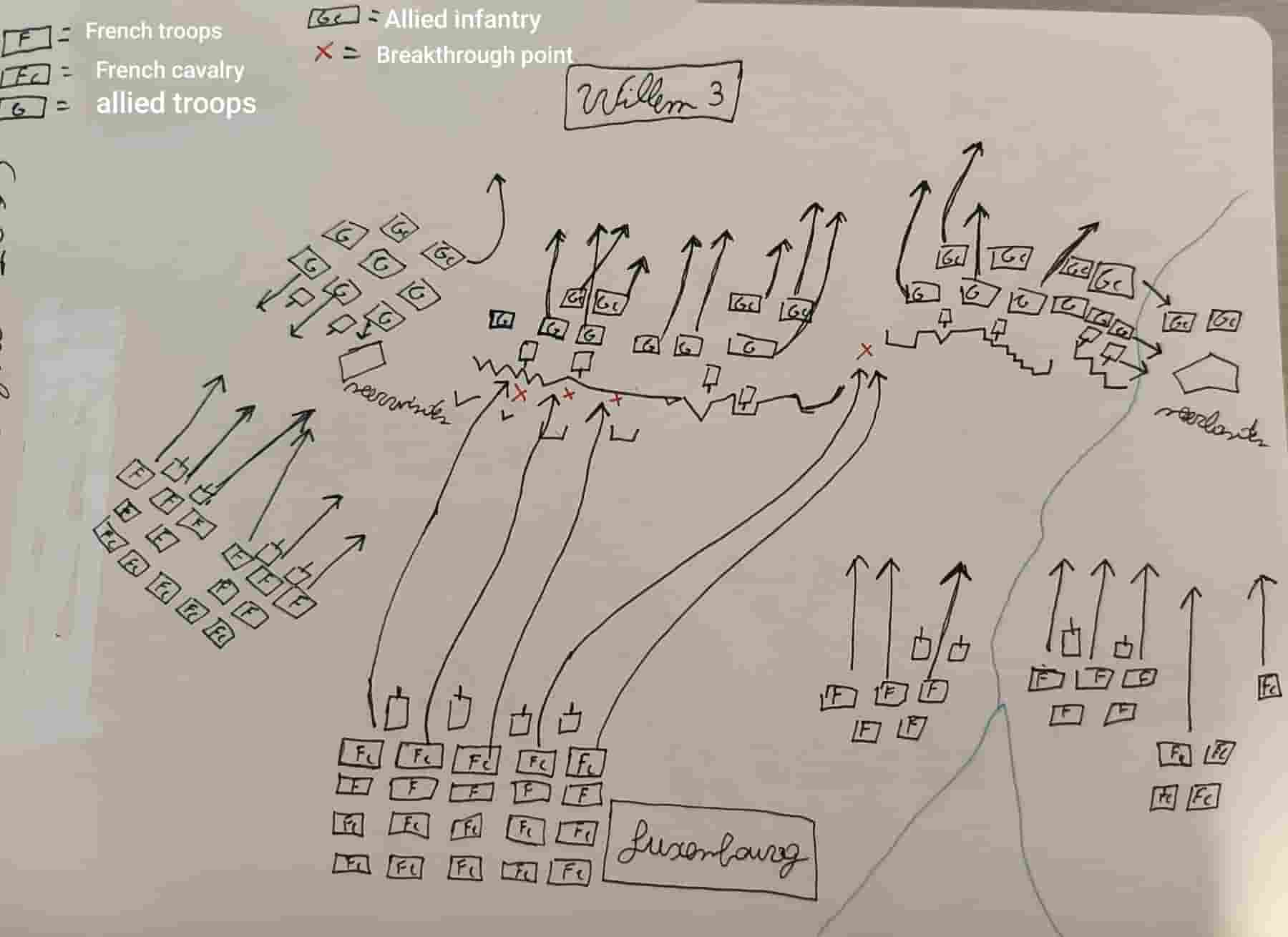
The main position stretched from Neerwinden on the Allied right, across the centre, to Neerlanden on the Allied left. The army faced south toward the approaching French. The villages were not isolated strongpoints; they formed the key points of a long defensive position several kilometres wide.
Neerwinden and the nearby village of Laar guarded the Allied right, where William expected the heaviest fighting. The centre consisted of open ground strengthened by earthworks, while the left rested around Neerlanden and the surrounding sunken roads and fields. Rumsdorp stood forward of the centre-left as an exposed position that could delay a French advance before it reached the main line.
The Allied troops worked throughout the night. They dug trenches and shallow ditches, raised banks of earth, built barricades across roads, and strengthened the walls and hedges around the villages. Houses, gardens, lanes, and farm buildings were turned into defensive positions. Artillery was placed behind the earthworks, where the guns could fire over the infantry and sweep the approaches. By dawn, the villages had become fortified anchors, linked together by trenches and fieldworks.
The position was not perfect. The Little Gete River lay behind the Allied army, meaning that the main line of retreat ran toward the bridges and crossings behind them. If the French broke through the right, the Allies could be pushed back against the river. William therefore had to hold Neerwinden and Laar at all costs.
He placed himself in the centre of the army, where he could move reserves toward whichever sector came under the greatest pressure. Maximilian II Emanuel, Elector of Bavaria, commanded the Allied right around Neerwinden and Laar. Henry Casimir II of Nassau-Diez held the Allied left around Neerlanden. The deployment gave William a strong defensive position, but it also created a danger: the army was spread across a wide front, and any major attack could force him to move troops from one sector to another.
Luxembourg understood this weakness immediately.
Luxembourg’s Plan
The French marshal did not intend to attack the entire Allied line with equal strength. Instead, he planned to pin William’s army in place while concentrating his main assault against the Allied right.
The French centre and right would launch supporting attacks toward the Allied centre-left and Neerlanden. These attacks did not necessarily need to break through. Their purpose was to keep the Allied troops occupied and prevent William from sending too many reinforcements toward Neerwinden.
The decisive attack would come from the French left, directed against Laar and Neerwinden. Luxembourg massed the greater part of his infantry in this sector, supported by powerful artillery batteries positioned to bombard the Allied defences before the infantry advanced. Once the guns had weakened the earthworks, French battalions would attack the villages directly, where the fighting would have to be done at close quarters with musket, bayonet, grenade, and sword.
Luxembourg also kept a large cavalry force near the centre. Its task was not to lead the first attack against the fortified villages. It was to wait for a breach. If the French infantry captured Neerwinden and broke through the Allied line, the cavalry could pass through the gap, form up behind the defences, and strike the Allied army during its retreat.
The plan was simple but dangerous: hold the Allies in place across the front, batter the right with artillery and infantry, seize the villages after repeated assaults, and then send the cavalry through the opening before William could reorganize.
By sunrise, the Allied army stood behind its new earthworks. Across the fields, Luxembourg’s army was forming for battle.
The villages were ready.
So were the guns.
National Army Museum — “Nine Years’ War.
Wikipedia — “Battle of Neerwinden.
Wikipedia — “Battle of Landen.
Belgium Battlefield — “First Battle of Neerwinden, 1693.”
De vergeten veldslagen van de lage landen Mart de Kruif, Théon Minten, Tom de Kruif (book)
The Cannonade Begins
The Battle of Neerwinden began on the morning of 29 July 1693 with one of the most violent artillery exchanges of the war. The Allied guns held the advantage at first, firing from prepared positions against dense French formations advancing across open ground.
The French centre was particularly exposed. Luxembourg had arranged his troops in tightly packed lines, and the Allied artillery tore into them as they moved forward. One French observer compared the cannonade to fighting at sea — so continuous and intense was the thunder of the guns.
The bombardment was already causing heavy casualties before the main assaults began. Count Solms, a senior Allied infantry commander, was mortally wounded during this opening phase. But the French army did not stop. Luxembourg’s plan depended on pressure: attacks in several sectors, repeated until the Allied line could no longer shift troops quickly enough to reinforce the point of danger.
The First Assault on Laar and Neerwinden
Between eight and nine in the morning, the first major French attack struck the Allied right. Twenty-eight French battalions advanced in several columns toward Laar and Neerwinden. Among the officers leading the assault was James FitzJames, Duke of Berwick, a future marshal of France and the illegitimate son of James II of England.
Laar fell relatively quickly. Neerwinden was another matter.
The village had been turned into a fortress of walls, hedges, gardens, houses, and barricades. Every lane became a firing position. Every building had to be taken separately. French soldiers forced their way forward, but the defenders refused to collapse. Berwick’s troops reached the edge of the village, while the French units on either side struggled to keep pace. Their attack began to lose its shape.
The situation became even more dangerous when French cavalry, having captured Laar, crossed the Laar Brook and attacked Spanish cavalry on the Allied flank. The Spanish were driven back at first, but then counterattacked and forced the French horse across the stream again. The fight around the villages was turning into a savage contest of short advances and sudden reverses.
William reacted quickly. He sent English battalions from the centre toward Neerwinden, and Maximilian of Bavaria led a counterattack against the exposed French formations. The Allied assault drove the French out of the village. Laar was also retaken. Berwick was captured, and the French commander Montchevreuil was killed.
The first French attack had failed.
But it had achieved one important result: it had shown Luxembourg exactly where the Allied line was strongest — and where it might still be broken.
Attacks Across the Front
While the battle raged around Neerwinden, Luxembourg ordered supporting attacks against the Allied centre and left. These assaults were not intended to achieve an immediate breakthrough. Their purpose was to keep William’s troops in place and prevent them from reinforcing the right.
French troops attacked Rumsdorp and Neerlanden. Rumsdorp fell, but the entrenched line behind it held. At Neerlanden, French dragoons fought their way into the village twice and were thrown out twice. Allied artillery switched to canister — metal balls and fragments fired at close range — and inflicted terrible losses on the French infantry in the narrow streets.
The attacks were costly, but they were not pointless. Every battalion William sent toward Neerwinden was a battalion no longer available elsewhere. Every French assault forced the Allies to reveal their reserves.
Luxembourg now prepared a second blow.
The Second Assault
Near midday, the French regrouped and attacked Laar and Neerwinden again. The pattern repeated itself. Laar was captured first, while Neerwinden resisted behind its walls and hedges. French troops penetrated slowly into the village, but the Allied defenders — including English Guards, Scottish Guards, and Dutch units — held on with extraordinary stubbornness.
William once again rode toward the crisis and brought English battalions from the centre. He personally led the counterattack that forced the French back from most of Neerwinden. Laar was recovered as well.
The villages had now changed hands repeatedly. Their streets were clogged with dead and wounded. The defensive works were broken, repaired, and broken again. Officers were falling at a rate that shocked even armies accustomed to terrible losses.
Luxembourg’s subordinates advised him to stop. His infantry had suffered heavily, the Allied artillery remained dangerous, and the French attacks had twice been repulsed. But Luxembourg still possessed a powerful reserve, including elite troops of the Maison du Roi, and his cavalry remained largely intact.
He decided to attack for a third time.
The Third Assault
This time, Luxembourg drew troops from other parts of the field and concentrated them against the Allied right. The French would attack with their full available strength, while the pressure continued elsewhere to prevent William from pulling back units in good order.
The assault began with renewed fury.
Laar and Neerwinden finally fell. The defenders had been weakened by hours of fighting, and many Allied units were running low on ammunition. French troops pushed through the villages and reached the Allied entrenchments.
The fighting now became a struggle for the entire defensive line.
French cavalry of the Maison du Roi charged Hanoverian cavalry but was checked by Dutch infantry. The Dutch then came under attack from French and Swiss Guards and were forced back. As the Allied formations shifted to meet the pressure, gaps began to appear in the line.
At the same time, French forces moving from Rumsdorp found that the centre was dangerously thin. The French seized the opportunity. Infantry crossed through the weakened sector and began forming cavalry on the far side of the Allied entrenchments. The Allied guns, threatened with capture, finally withdrew.
At approximately three in the afternoon, the French broke through.
The Retreat to the Gete
An hour later, William ordered the Allied army to retreat across the Gete. The withdrawal was extremely dangerous. Much of the Allied artillery had been placed inside earthworks and could not be removed quickly. Dozens of guns were abandoned.
The French cavalry now surged through the breach. More than a hundred squadrons crowded into the space behind the Allied line, and the retreat threatened to become a complete collapse. Maximilian’s German and Spanish troops were overwhelmed as they attempted to cross the river. Some cavalrymen drowned in the confusion.
William refused to let the army disintegrate.
He personally led repeated cavalry charges against the French, buying time for the retreating infantry to reach the crossings. At one point he was nearly captured. His rearguard fought desperately around the bridges, holding back the French long enough for the main army to escape.
The Allied left under Henry Casimir withdrew in better order. Dutch and Danish troops fought their way through French attacks over several kilometres before reaching the river. A small group of isolated Dutch and Danish battalions conducted a stubborn rearguard action near Rumsdorp and eventually crossed safely.
By around five in the afternoon, most of the Allied army had reached the far side of the Gete. The battle was a French victory, but William’s rearguard action had prevented it from becoming a catastrophe on the scale Luxembourg had hoped for.
The French held the field. The Allies had lost their guns. But the army itself had survived.
National Army Museum — “Nine Years’ War.
Wikipedia — “Battle of Neerwinden.
Wikipedia — “Battle of Landen.
Belgium Battlefield — “First Battle of Neerwinden, 1693.”
De vergeten veldslagen van de lage landen Mart de Kruif, Théon Minten, Tom de Kruif (book)
William Chooses to Stand
The first turning point came before the battle began. William had been caught in a dangerous position, with the Little Gete behind him and the French approaching in superior numbers. A night retreat might have saved the army from battle, but the movement would have been difficult to organize and vulnerable to French cavalry. William chose to remain and fortify the villages.
That decision gave the Allies a strong defensive position — but it also placed their only reliable line of retreat behind the right flank. If Neerwinden and Laar fell, the entire Allied army would be forced toward a narrow series of crossings.
The Villages Hold
The second turning point was the failure of the first two French attacks. Neerwinden and Laar were not taken easily. The Allied defenders used walls, hedges, houses, and prepared earthworks to turn the villages into killing grounds. William’s personal intervention repeatedly restored the line.
These failed assaults cost the French thousands of men and gave the Allies time to counterattack. But they also fixed the battle in place. Luxembourg kept the Allied army focused on the right while his troops elsewhere maintained enough pressure to prevent large-scale reinforcement.
The villages saved the Allied army — until they no longer could.
Luxembourg Refuses to Stop
The third turning point was Luxembourg’s decision to launch a third assault after two costly failures. Many commanders would have broken off the attack. Luxembourg recognized that the French still possessed fresh reserves and that the Allied defenders were becoming exhausted.
He concentrated additional troops against the right and attacked again with overwhelming force. The French did not win because the first assault succeeded. They won because Luxembourg was willing to keep attacking after it had failed.
The Cavalry Breakthrough
The decisive moment came when the French broke through the Allied entrenchments after Neerwinden and Laar finally fell. French cavalry poured through the gap and formed behind the Allied line.
The Allied army was now caught while attempting to change position. French horsemen struck the exposed columns, scattering them before they could reform. The entire battle suddenly changed character: what had been an infantry struggle around fortified villages became a desperate cavalry battle behind the defensive line.
National Army Museum — “Nine Years’ War.
Wikipedia — “Battle of Neerwinden.
Wikipedia — “Battle of Landen.
Belgium Battlefield — “First Battle of Neerwinden, 1693.”
De vergeten veldslagen van de lage landen Mart de Kruif, Théon Minten, Tom de Kruif (book)
The breakthrough did not destroy William’s army only because the king personally organized the retreat and led repeated countercharges.
Victory Without Annihilation
The final turning point came after the French victory. Luxembourg had forced the Allies from the field and captured most of their artillery, but exhaustion prevented a full pursuit. The French army had paid an enormous price for its success, and its soldiers were too battered to turn the retreat into total destruction.
Neerwinden was therefore a great tactical victory, but not the decisive strategic victory Louis XIV wanted. William had lost the battlefield, yet he had saved the army — and an intact army could fight again.
The Cost of Victory
The French victory at Neerwinden was one of the bloodiest battles of the Nine Years’ War. The French army had entered the battle with roughly 70,000–80,000 troops and 70 guns, while the Allied army — made up of Dutch, English, German, and Spanish troops — numbered around 50,000–60,000 men with 80–100 guns.
The Allies suffered approximately 12,000–20,000 killed, wounded, and captured, as well as losing most of their artillery. French losses were also severe, with around 12,000–15,000 men killed or wounded.
The result was therefore sometimes described as a Pyrrhic victory: a victory so costly that it weakened the army that won it almost as severely as the army that lost. The French had captured the Allied position and driven William’s army from the field, but Luxembourg’s troops had paid an enormous price for the success.
A Victory That Could Not End the War
Louis XIV had hoped that a major victory would split the Grand Alliance and force William to negotiate. Neerwinden did nothing of the sort. William quickly replaced his losses, and the Allied army remained capable of defending the Spanish Netherlands.
Luxembourg’s army was too exhausted to exploit the victory by marching on Brussels or Liège. The French had won the battlefield, but they had not destroyed the Allied army or forced the coalition out of the war. The military situation therefore remained unresolved in the years that followed.
Neerwinden had defeated William’s army, yet it had not removed William from the war or opened the road to the Dutch Republic.
The Road to Charleroi
Instead of advancing on Brussels or Liège, Luxembourg and Louis XIV settled for a more limited objective. The French army moved against Charleroi, a strategically useful fortress in the Spanish Netherlands. Its Spanish garrison resisted for more than a month before surrendering on 13 October 1693.
It was a respectable gain, but not the collapse of the Grand Alliance that Louis XIV had wanted. Neerwinden had been a major French victory, but its price had been so high that France could not turn it into the decisive breakthrough Louis desired.
William’s Answer
William understood the lesson immediately. The Allied armies were too small to protect every fortress and frontier at once, especially against France’s enormous forces. In the following years, England and the Dutch Republic increased their military commitment in the Low Countries.
The response was gradual, but effective. In 1694 the Allies recovered Huy. In 1695 William captured Namur, the fortress that Louis XIV had taken three years earlier and strengthened under the direction of Sébastien de Vauban. The recovery of Namur became William’s greatest triumph of the war.
Neerwinden had shown the Allies how dangerous French concentration could be. It also convinced them that survival was not enough; they needed larger armies capable of taking the initiative.
The Last Battle of a Great Marshal
Neerwinden was the final great victory of Marshal Luxembourg. He had defeated William at Steenkerque and again at Landen, proving himself one of the most formidable field commanders of the age. But he died in January 1695, only months after the battle.
His death removed one of Louis XIV’s finest commanders at the moment France most needed experienced leadership. The French would continue to fight successfully, but the war was increasingly becoming a struggle of resources rather than a contest that could be decided by a single battlefield victory.
The Nine Years’ War ended with the Treaty of Ryswick in 1697. France retained some gains, but Louis XIV was forced to recognize William as the legitimate king of England and surrender several important conquests. The central issues behind the war remained unresolved, and Europe would soon be dragged into another enormous conflict over the Spanish succession.
National Army Museum — “Nine Years’ War.
Wikipedia — “Battle of Neerwinden.
Wikipedia — “Battle of Landen.
Belgium Battlefield — “First Battle of Neerwinden, 1693.”
De vergeten veldslagen van de lage landen Mart de Kruif, Théon Minten, Tom de Kruif (book)
The battle of Neerwinden (1693) or the battle of Landen
The Battle of Landen and the Battle of Neerwinden are two names for the same battle, fought on 29 July 1693 during the Nine Years' War. "Landen" refers to the nearby town, while "Neerwinden" is the village where most of the fighting actually happened — so historians and history books use the names interchangeably. If you've seen both floating around, you haven't stumbled onto two different events; you're looking at the same French victory over William III's Allied army.
Two Battles of Neerwinden: 1693 vs 1793
Confusingly, Neerwinden hosted two major battles almost exactly a century apart. The 1693 clash between France and William III's Allied forces is the one covered here — often called the First Battle of Neerwinden to tell it apart from its sequel. In 1793, Austrian troops defeated a French Revolutionary army on almost the same ground, in what's now known as the Second Battle of Neerwinden. Same village, same name, completely different war.
William III Narrowly Escapes Capture at Neerwinden
In the chaos of the retreat, French troops came within reach of capturing William III outright. He got away, but just barely — and it easily could have gone the other way. Nanden was already a French victory; if William had been taken prisoner too, the shockwaves across European politics could have been massive.
Wikipedia — Battle of Landen.
Wikipedia — Battle of Neerwinden .
Wikiwand - Battle of Landen
Wikpedia - Slag bij Neerwinden 1793
The Ground
Where it was fought
Gallery
Images
Test yourself
Quiz
Question 1
What conflict was the Battle of Neerwinden part of?
Question 2
Luxembourg's officers advised him to stop attacking after two failed assaults, but he attacked a third time anyway.
Question 3
What did William personally do to prevent the retreat from becoming a total collapse?
Question 4
What term describes a victory so costly it weakens the winning side?
Question 5
William III held both the English throne and the position of Stadtholder of the Dutch Republic.
Question 6
What was the purpose of Luxembourg's supporting attacks on the Allied centre and left?
Question 7
What finally happened to the Allied guns as the French broke through?
Explore more
You Might Also Like
Ranked by country match, then era, then how close the battles were in time.