The Battle of Waterloo was fought on 18 June 1815 and ended Napoleon Bonaparte’s final attempt to restore French dominance in Europe. What happened at Waterloo? Napoleon attacked the Anglo-Allied army of the Duke of Wellington near Brussels before Gebhard von Blücher’s Prussian army could arrive. The French opened with artillery fire and attacks on key positions such as Hougoumont, followed by Comte d’Erlon’s infantry assault and Michel Ney’s massive cavalry charges. Wellington’s troops held their defensive ridge, forming infantry squares against the cavalry and resisting repeated attacks despite heavy losses. Later in the day, Prussian forces arrived on the French right flank and fought for Plancenoit, forcing Napoleon to divide his army. Napoleon then sent the Imperial Guard forward in a final attempt to break Wellington’s centre, but the attack was repulsed. Wellington ordered a general advance as the Prussians pressed the French flank, causing the French army to collapse and retreat. France lost about 27,000 men, with another 8,000–9,000 captured, while Coalition losses were about 24,000. Waterloo ended Napoleon’s rule and brought the Napoleonic Wars to a close.
Outcome
Coalition victory
Commanders
Napoleon BonaparteArmy commander · France
Michel NeyCavalry commander, led the big charges · France
Comte d'ErlonI Corps commander, 4 infantry divisions · France
Emmanuel de GrouchyRight wing, sent to chase the Prussians · France
Duke of WellingtonArmy commander · Coalition
William, Prince of OrangeI Corps commander, Dutch-Belgian divisions · Coalition
Gebhard von BlucherPrussian army commander · Coalition
Forces engaged
French TotalAbout 72,000
French CavalryAbout 15,000
Coalition TotalAbout 116,000-118,000
French InfantryAbout 50,000
French ArtilleryAbout 7,000 men, 246 guns
Coalition ArtilleryAbout 285 guns
Casualties
French TotalAbout 27,000
Coalition TotalAbout 24,000
French CapturedAbout 8,000-9,000
Region
Walloon Brabant
Coordinates
50.678, 4.412
Chronicle
What happened
I
Chapter 1 of 4
Background
Napoleon Returns
On 1 March 1815, Napoleon Bonaparte landed in southern France after escaping exile on Elba. Less than a year earlier, the European powers had forced him into exile and restored the Bourbon monarchy. Now he was back.
His return was astonishing. Soldiers sent to arrest him instead joined him. King Louis XVIII fled Paris, and within weeks Napoleon had regained the French throne without fighting a major battle. This brief return became known as the Hundred Days.
But the rest of Europe would not accept it.
Britain, Prussia, Austria, Russia, and several smaller states formed the Seventh Coalition. Their armies began gathering around France. Napoleon understood that he could not survive a long war against all of them. His only chance was to strike first in Belgium, defeat the British-led and Prussian armies before the Austrians and Russians could arrive, and then force the Coalition to negotiate.
The Belgian Gamble
Napoleon moved north in June 1815 with the Armée du Nord, the Army of the North. He had about 72,000 men, including around 50,000 infantry, 15,000 cavalry, and approximately 7,000 artillerymen operating 246 guns.
Across the border were two armies. The first was commanded by the Duke of Wellington, whose force included British, Dutch-Belgian, Hanoverian, Brunswick, and German troops. The second was the Prussian army under Gebhard von Blücher.
Together, the Coalition forces eventually numbered around 116,000–118,000 men, supported by roughly 285 guns. But they were not together at the start. Napoleon’s plan was to drive between them, defeat each army separately, and prevent Wellington and Blücher from combining.
On 16 June, Napoleon defeated the Prussians at Ligny. It was a French victory, but not the destruction Napoleon needed. Blücher’s army withdrewlnorthward, battered but still intact.
Meanwhile Wellington withdrew toward the village of Waterloo south of Brussels after losing the battle of Quatre Bras. He chose a defensive position along a low ridge near the Brussels road. His troops could shelter behind the crest, hidden from French artillery until they rose to fire. Three strongpoints stood in front of the line: the walled farm of Hougoumont on the Allied right, La Haye Sainte near the centre, and the farm of Papelotte toward the left.
Napoleon sent Emmanuel de Grouchy with about 33,000 men to follow the retreating Prussians and keep them from joining Wellington. But Napoleon had guessed wrong about where they had gone. Instead of retreating east away from Wellington, the Prussians had fallen back north to Wavre and where a half a day marching away from Waterloo. On 18 June Blücher left Thielmann’s III Corps at Wavre to keep Grouchy distracted and marched the rest of his army west toward Waterloo.
Wellington’s task was simple but brutal hold long enough for the Prussians to arrive. the battle would therefore become a race.
Could Napoleon break Wellington before Blücher arrived or could Grouchy return fast enough?
National Army Museum — Battle of Waterloo.
Encyclopaedia Britannica — Battle of Waterloo.
Cambridge Digital Library — Waterloo.
wikipedia - battle of Waterloo
De vergeten veldslagen van de lage landen Mart de Kruif, Théon Minten, Tom de Kruif (book)
Apple Original Films / Sony Pictures — Napoleon (2023), directed by Ridley Scott.
Rain, Mud, and Waiting
Rain fell heavily during the night of 17–18 June. By morning, the battlefield was soaked. The open ground between the French and Allied ridges had become deep, muddy farmland.
Napoleon delayed his main attack until late morning. He wanted the ground to dry enough for his artillery to move and for cannonballs to bounce through Allied formations rather than bury themselves in wet soil. This was a reasonable military concern, but it carried a heavy cost: every hour of delay gave the Prussians more time to reach Wellington.
At around 11:30 a.m., the battle began with an attack on Hougoumont.
Hougoumont: The Battle Inside the Battle
Hougoumont was a walled farm complex on the Allied right. Napoleon appears to have intended the attack as a diversion, hoping Wellington would send reserves there and weaken his centre.
Instead, the attack became a battle of its own.
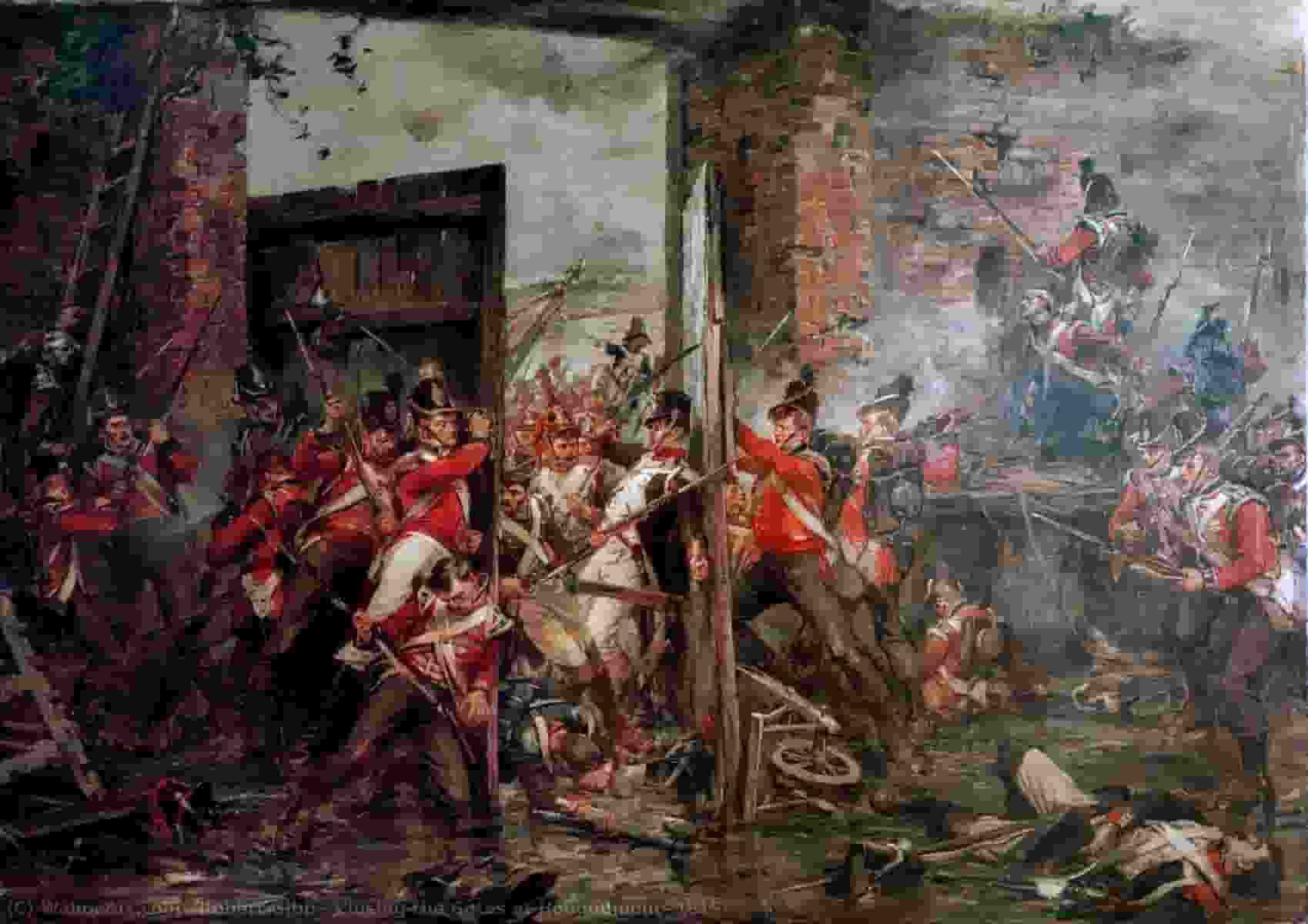
French infantry entered the woods around the farm and launched repeated assaults against its walls, gates, gardens, and buildings. At one point, French soldiers forced open the main gate, but Allied guardsmen slammed it shut again in a desperate struggle at close range.
The French attacked Hougoumont throughout the day. The defenders were reinforced again and again, and the farm never fell.
The result was costly for Napoleon. What had begun as a diversion consumed thousands of French troops who could have been used elsewhere.
Around midday a Grand Battery of about 80 French guns opened fire on Wellington’s left-centre to soften the line before the first assault.
D’Erlon’s Attack
At about 1:30 p.m. Napoleon launched his first major attempt to break Wellington’s main line.
Comte d’Erlon’s I Corps advanced with four infantry divisions, roughly 17,000 men, against the Allied left-centre. The French columns moved uphill through cannon fire toward the ridge, aiming to break through near La Haye Sainte and split Wellington’s army before the Prussians arrived.
For a moment, the attack almost worked.
French infantry pushed back Dutch-Belgian troops and struck the Allied line hard. But Wellington’s infantry held behind the ridge, firing at close range. Then British heavy cavalry (the Household Brigade and the Union Brigade) charged downhill into the French columns.
The cavalry smashed into d’Erlon’s men, broke the attack, and captured French eagles. But the British cavalry rode too far in pursuit. French lancers and cuirassiers counterattacked, inflicting heavy losses and leaving the Allied cavalry exhausted.
D’Erlon’s assault had failed.
But Wellington’s line had been badly shaken.
The Prussians Arrive
During the afternoon, Napoleon received the news he had feared: troops were appearing on the French right, near the village of Plancenoit.
They were Prussians.
The first Prussian corps to arrive was commanded by Friedrich von Bülow. Its attack did not immediately destroy the French right, but it created a problem Napoleon could not ignore. If the Prussians captured Plancenoit, they could threaten the French rear and cut the road south — Napoleon’s only reliable route of retreat.
Napoleon had to send troops away from the battle against Wellington to defend the village.
The French were now fighting two armies at once.
Ney’s Cavalry Charges
Later in the afternoon, Marshal Michel Ney saw movement on Wellington’s ridge and believed the Allied army might be withdrawing. It was probably not a general retreat but many troops were moving wounded repositioning or sheltering behind the crest.
Ney ordered a massive cavalry attack.
French cuirassiers, lancers, and mounted chasseurs charged uphill toward the Allied centre. They expected to catch Wellington’s infantry while it was moving. Instead, they found the troops formed into squares.
A square was a compact infantry formation: soldiers stood in several ranks, facing outward in all directions, with bayonets and muskets ready. Cavalry could ride around the square, threaten it, and fire pistols into it but charging directly into a wall of bayonets was extremely dangerous.
The French cavalry charged again and again.
They rode around the squares, captured some guns, and attacked the formations from different directions. But without enough infantry and horse artillery to support them, they could not break the Allied infantry.
Every charge cost horses and men. Every repulse made the French cavalry weaker.
La Haye Sainte Falls
At around 6 p.m., French troops finally captured La Haye Sainte, the farm in front of Wellington’s centre. Its defenders, mostly from the King’s German Legion, had run low on ammunition after hours of fighting.
The fall of the farm created a genuine crisis.
French guns could now move closer to the Allied ridge, firing into the centre at short range. French skirmishers pushed forward, and Wellington’s line was thinner than ever. Some Allied units had been reduced to fragments.
This was probably Napoleon’s best chance to win the battle.
But the Prussian pressure around Plancenoit was increasing, and French troops were still being pulled away from the main attack to stop them.
The Imperial Guard
As evening approached, Napoleon made his final gamble.
He sent forward elements of the Imperial Guard, the elite infantry reserve of the French army. The Guard was expected to break Wellington’s centre-right, push the Coalition army from the ridge, and turn the battle before the Prussians could overwhelm the French right.
The Guard advanced through smoke and artillery fire toward the ridge.
Wellington’s troops waited until the French were close. Then Allied infantry rose from behind the crest and fired into them at short range. British Guards, supported by Dutch-Belgian, Hanoverian, and other Allied units, held the line.
The Imperial Guard got caught by surprise.
It stopped. Then it desperately fell back.
The retreat of the Guard did not instantly destroy the entire French army, but it shattered confidence. For much of Europe the Guard seemed unbeatable. When it withdrew, French soldiers understood that the final attack had failed.
Wellington saw the moment and ordered a general advance.
At the same time, the Prussians broke through at Plancenoit. The French line began to collapse.
The Rout
The French retreat turned into chaos.
Some units, especially parts of the Old Guard, fought rearguard actions to cover the escape. But much of the army fled south along the road toward Charleroi, abandoning guns, wagons, wounded men, and equipment.
Napoleon escaped the battlefield, but the Army of the North had been broken.
Waterloo was over.
National Army Museum — Battle of Waterloo.
Encyclopaedia Britannica — Battle of Waterloo.
Cambridge Digital Library — Waterloo.
wikipedia - battle of Waterloo
De vergeten veldslagen van de lage landen Mart de Kruif, Théon Minten, Tom de Kruif (book)
Apple Original Films / Sony Pictures — Napoleon (2023), directed by Ridley Scott.
The Prussian Army Survives Ligny
The first turning point came two days before Waterloo. Napoleon defeated Blücher at Ligny, but he did not destroy the Prussian army.
The Prussians tricked Grouchy in a way that allowed them to remain within a day's march of Wellington rather than retreating eastward away from him. This made it possible for them to march toward Waterloo on 18 June.
Napoleon’s plan depended on defeating the Coalition armies separately. Ligny was a victory but it was not decisive enough.
The Morning Delay
The second turning point was the delayed French attack.
Napoleon waited for the muddy ground to improve, hoping to use artillery more effectively. But the delay gave Bülow’s Prussian corps valuable hours to march toward the battlefield.
This does not mean the rain “lost” Waterloo by itself. But it made Napoleon’s timetable much harder. His battle plan depended on defeating Wellington before Blücher arrived.
D’Erlon Is Repulsed
The third turning point was the defeat of d’Erlon’s I Corps.
This was Napoleon’s first major attempt to break Wellington’s line. It came close to success but was stopped by Allied infantry and the British heavy cavalry countercharge. The French lost momentum, while the Coalition army gained time.
Every failed French attack made the arriving Prussians more important.
Ney’s Charges Fail
The fourth turning point was Ney’s cavalry assault.
French cavalry was powerful, but cavalry alone could not break disciplined infantry squares. Ney’s charges lacked enough infantry and artillery support, and the French horsemen became exhausted after repeated attacks.
The charges showed French courage, but they spent one of Napoleon’s strongest resources without creating the breakthrough he needed.
A Breakthrough Napoleon Could Not Exploit
Around 6 p.m., the French captured La Haye Sainte, opening the way for guns to move closer and batter Wellington’s centre at short range. It was the opening Napoleon had been waiting for. But at the same time, the Prussians were pressing into Plancenoit behind his right flank. Instead of throwing all his available troops against Wellington’s weakened line, Napoleon had to send men to protect his own rear and right. Just as victory seemed within reach, he was being forced to fight in two directions.
The Guard Is Repulsed
The final turning point was the failure of the Imperial Guard.
By the time it attacked, Wellington’s army was exhausted and under pressure, but the Prussians were also arriving in greater strength. The Guard had to succeed quickly.
It did not.
Once the Guard fell back, Wellington advanced and the Prussians pressed harder into the French right. The battle became a retreat, and the retreat became a rout.
National Army Museum — Battle of Waterloo.
Encyclopaedia Britannica — Battle of Waterloo.
Cambridge Digital Library — Waterloo.
wikipedia - battle of Waterloo
De vergeten veldslagen van de lage landen Mart de Kruif, Théon Minten, Tom de Kruif (book)
Apple Original Films / Sony Pictures — Napoleon (2023), directed by Ridley Scott.
The Cost of Waterloo
The battle cost both sides heavily. The French lost about 27,000 men, including around 8,000–9,000 captured. Coalition casualties were about 24,000.
The French losses were especially damaging because Napoleon could not easily replace them. The Army of the North was not merely defeated; it was scattered, with its artillery, wagons, and equipment abandoned during the retreat.
Napoleon Abdicates Again
Napoleon returned to Paris on 21 June. He tried to organize a new defence, but the political situation had collapsed. The Coalition armies were advancing toward France, and the French government no longer trusted that Napoleon could save the country.
On 22 June, he abdicated for the second and final time.
He hoped to escape to the United States, but British naval patrols prevented him from leaving France. In July, he surrendered to the British and was sent into exile on the remote Atlantic island of Saint Helena.
He died there in 1821.
Europe After Waterloo
Waterloo ended Napoleon’s Hundred Days return and confirmed the restoration of the Bourbon monarchy in France. It also ended more than two decades of revolutionary and Napoleonic war that had reshaped Europe.
The Congress of Vienna continued its work of building a new European balance of power. France remained an important state, but it was contained by stronger neighbours and occupied temporarily by Coalition troops.
The battle did not create permanent peace everywhere. Europe would still see wars, revolutions, and rivalries. But no conflict on the scale of the Napoleonic Wars returned for nearly a century.
A Name That Became a Metaphor
Waterloo became more than a battlefield. In English and many other languages, to “meet one’s Waterloo” means to suffer a final, decisive defeat.
That phrase survives because the battle was not simply Napoleon’s last loss. It was the moment when one of history’s most successful commanders ran out of time, reserves, and chances.
At Waterloo, he nearly broke Wellington.
But Blücher arrived.
National Army Museum — Battle of Waterloo.
Encyclopaedia Britannica — Battle of Waterloo.
Cambridge Digital Library — Waterloo.
wikipedia - battle of Waterloo
De vergeten veldslagen van de lage landen Mart de Kruif, Théon Minten, Tom de Kruif (book)
Apple Original Films / Sony Pictures — Napoleon (2023), directed by Ridley Scott.
The Ground
Where it was fought
Explore more
You Might Also Like
Ranked by country match, then era, then how close the battles were in time.