Why Did British Soldiers Walk Across No Man’s Land at the Somme?
France
Some British soldiers walked at the Somme because their commanders ordered a steady, organised advance, believing the preliminary bombardment would destroy German defences. Heavy equipment also limited their speed. However, not all units walked: some rushed forward or moved into no man’s land before the attack began. Many German dugouts and machine-gun positions survived, exposing the advancing troops to devastating fire.
The Battle of the Somme (1 July–18 November 1916) was a major British and French offensive against Germany on the Western Front. Intended to break German lines and relieve pressure on Verdun, it began with a disastrous first day that cost the British Army more than 57,000 casualties. Months of fighting brought limited territorial gains but inflicted heavy losses on both sides. Despite improved artillery tactics and the first use of tanks in battle, the Allies failed to achieve a decisive breakthrough.
Outcome
inconclusive
Commanders
Douglas HaigBritish commander-in-chief · British Empire
Henry RawlinsonFourth Army; main offensive · British Empire
Hubert GoughReserve Army, later Fifth Army · British Empire
Ferdinand FochNorthern Army Group commander · France
Émile FayolleSixth Army commander · France
Fritz von BelowSecond Army, later First Army · Germany
Max von GallwitzSecond Army and army group · Germany
Forces engaged
French InitialAbout 330,000
German InitialAbout 240,000
British InitialAbout 390,000
Casualties
French CasualtiesAbout 200,000
German CasualtiesAbout 434,000–650,000
British Empire CasualtiesAbout 420,000
Region
Hauts-de-France
Coordinates
50.016, 2.697
Chronicle
What happened
I
Chapter 1 of 4
Background
The Offensive That Could Not Wait
By the summer of 1916, the Western Front had become a fortified barrier stretching across France and Belgium. Trenches, barbed wire, machine guns, and artillery had made movement painfully difficult. An army could capture a trench and still find another defensive line waiting behind it.
Britain and France planned to break this deadlock with a major offensive around the River Somme in northern France. It was intended to form part of a wider Allied effort: attack Germany and its allies on several fronts, stretch their reserves, and prevent them from concentrating against one opponent at a time.
Originally, the French were expected to provide much of the attacking strength. Then, in February, Germany attacked Verdun.
The fighting there consumed French divisions and ammunition at an alarming rate. The Somme offensive now had another urgent purpose: draw German troops away from Verdun before the French army was exhausted. With fewer French formations available, the British took responsibility for a larger share of the attack.
For General Sir Douglas Haig, commander of the British Expeditionary Force, this created a difficult situation. His army was much larger than it had been in 1914, but many of its soldiers were inexperienced volunteers. They were being asked to carry out a complicated offensive against an enemy that had spent months strengthening its positions.
Waiting would allow more preparation.
But France needed help now.
An Army Beneath the Ground
The German defenders held trenches, fortified villages, and positions along ridges overlooking the approaches. Beneath them, deep dugouts offered protection from bombardment. Barbed wire covered the ground in front, while machine-gun positions were arranged to fire across the paths the attackers would have to take.
Breaking this system required more than courage or superior numbers. The attackers needed artillery to cut the wire, destroy strongpoints, suppress German guns, and keep the defenders under cover while the infantry crossed the open ground between the armies. If the bombardment failed, the infantry would face weapons it could do little to silence.
General Sir Henry Rawlinson’s British Fourth Army would make the main British attack, supported by part of the Third Army farther north. General Émile Fayolle’s French Sixth Army would attack to the south. Haig hoped that the offensive could break the German defensive system and create an opportunity to advance beyond it.
On 24 June, the British began a seven-day preliminary bombardment. Roughly 1.5 million shells struck the German positions.
The noise was immense. The destruction looked overwhelming.
But would it acctually work?
National Army Museum — Battle of the Somme
Wikipedia - Battle of the Somme
Imperial War Museums — First World War Galleries Podcast: Part V — Total War
youtubue - The Battle Of The Somme Full Documentary by DocoBase
Haig’s Plan
Haig believed that a massive artillery bombardment could destroy the German defences before the infantry advanced. If the guns cut the wire, smashed the trenches, and forced the defenders underground, the British troops could cross the open ground and take the first German line.
Once that happened, he hoped the attack could be pushed forward into the German rear. The Somme was not meant to be a slow grind from the start. Haig wanted a break through an opening through which cavalry and fresh troops could advance and turn a successful attack into a wider victory.
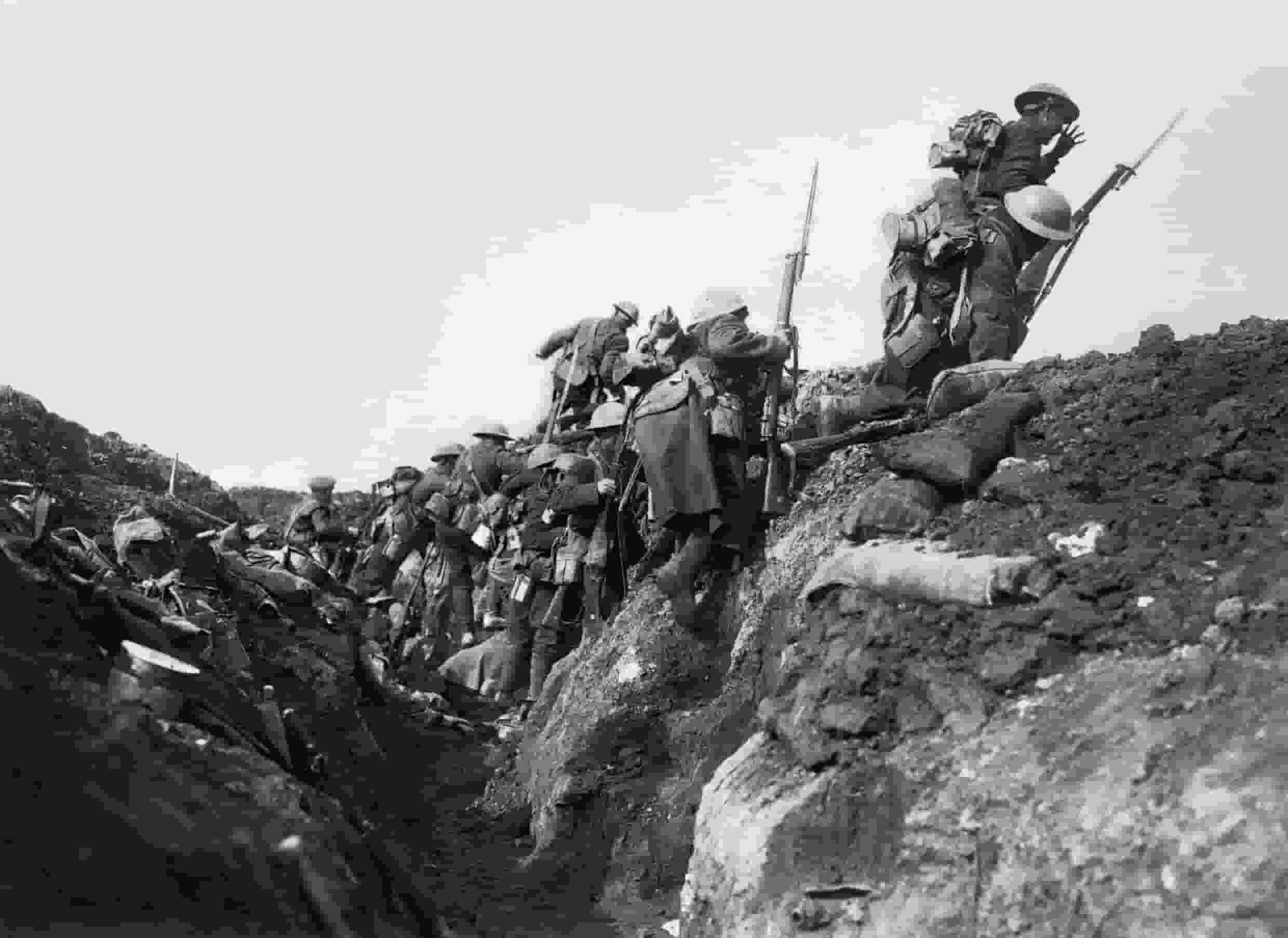
at 7:30 a.m. on 1 July 1916, the British infantry went over the top.
Many soldiers advanced at a steady walking pace. They had been told that the German defences would already be destroyed, and commanders feared that if men ran, they would become exhausted or lose formation before reaching the enemy. In some sectors, troops carried heavy equipment or had to cross several hundred yards (meters) of open ground.
But then the German machine guns and artillery opened fire.
Soldiers who had expected to cross a ruined battlefield found belts of wire still intact. Men were cut down in front of the German positions, trapped in the open ground with nowhere to take cover. Others reached the trenches only to find the defenders emerging from dugouts that the bombardment had failed to destroy.
The attack became a disaster within minutes.
In some places, British troops did capture sections of the German front line, especially in the south, the French achieved substantial gains. But across much of the British front, the assault collapsed under fire before it could reach the German line.
By the end of the day, the British Army had suffered approximately 57,000 casualties, including 19,000 dead. It remains the bloodiest day in British Army history.
A Disaster That Did Not End
The first day was a catastrophe, but the offensive continued.
The French were still advancing, British troops had gained ground in some southern sectors, and the pressure on Verdun made it difficult to stop. Haig shifted the main effort toward the southern part of the battlefield, where the attack had worked better.
On 14 July, British troops attacked before dawn around Bazentin Ridge after a much shorter bombardment (roughly 5 minutes). This time, surprise worked: the Germans were caught off guard and important positions were captured.
But success did not become breakthrough. Reinforcements, artillery, and supplies had to cross the same broken ground, while German reserves arrived and counterattacked. The offensive became a series of battles for villages, woods, and ridges — places such as Delville Wood, Pozières, and Thiepval — where every gain had to be defended against artillery and counterattack.
On 15 September, the British used tanks for the first time at Flers and Courcelette. The new machines alarmed German troops and helped in some local attacks, but there were too few of them, and many broke down in the mud. They could not transform the battle.
By November, rain had turned the battlefield into mud. On 18 November, Haig ended the offensive.
The Allies had pushed the German line back by roughly six miles at its deepest point. They had not achieved the breakthrough.
National Army Museum — Battle of the Somme
Wikipedia - Battle of the Somme
Imperial War Museums — First World War Galleries Podcast: Part V — Total War
youtubue - The Battle Of The Somme Full Documentary by DocoBase
The Cost of the Somme
The losses were enormous. The British Empire suffered approximately 420,000 casualties, and France around 200,000. German estimates vary considerably, but roughly 450,000–500,000 casualties are commonly cited. These figures include men killed, wounded, captured, or missing; they are not death totals.
The damage extended far beyond the armies. Villages disappeared beneath rubble, farmland became a maze of trenches and shell holes, and civilians lost homes and livelihoods.
In Britain, the first day left a particularly deep wound. On 1 July alone, the British Army suffered about 57,000 casualties, including roughly 19,000 killed Many volunteer battalions had recruited men from the same towns, workplaces, and communities. When those battalions suffered heavily, the losses were concentrated at home as well as on the battlefield.
What the Offensive Achieved
The Somme failed to deliver the breakthrough its commanders had hoped for. German troops were not driven out of northern France, and the Western Front did not return to open warfare.
But the offensive was not without military consequences.
It drew German troops and resources into a sustained defensive battle, helped relieve some pressure on Verdun, and inflicted losses on experienced German officers and soldiers who were difficult to replace. It also gave the expanding British Army hard-earned experience in artillery coordination, infantry tactics, logistics, and the handling of large offensives.
None of this makes the cost easy to justify. It explains why many historians distinguish between the failure to break through and the wider effect of wearing down the German army.
The Somme could be a terrible disappointment for the Allies and a damaging battle for Germany at the same time.
A War Still Unfinished
When the offensive ended, neither side had escaped the underlying problem of trench warfare. The Allies could assemble enormous forces and capture fortified ground, but they could not yet reliably turn those gains into a decisive advance.
The war would continue for another two years.
The Somme left behind no simple result to match its scale. There had been local victories, devastating failures, tactical improvements, and losses on a scale that changed entire communities.
National Army Museum — Battle of the Somme
Wikipedia - Battle of the Somme
Imperial War Museums — First World War Galleries Podcast: Part V — Total War
youtubue - The Battle Of The Somme Full Documentary by DocoBase
Why did the British artillery fail at the Somme?
the British Artillery at the Somme failed for several reasons
1: many shells were duds and did not explode (roughly 30%) and others were the wrong type shrapnel shells were useful against men in the open but did little damage to deep dugouts or thick barbed wire (note: Shrapnel was actually the standard wire-cutting shell. The problem was that it couldn’t cut thick, deep lines of wire or touch dugouts, and they were too little high explosive.)
2: The German defences were also much stronger than the British expected. Many German soldiers sheltered in deep dugouts where ordinary shells could not reach them. When the bombardment lifted, they climbed out, set up their machine guns, and fired on the advancing infantry.
3: The British also had too few heavy guns for such a stretched front ,their artillery could not accurately destroy the German batteries. As a result, German artillery remained active and could shell British troops crossing No Man’s Land.
National Army Museum — Battle of the Somme
Wikipedia - Battle of the Somme
Imperial War Museums — First World War Galleries Podcast: Part V — Total War
youtubue - The Battle Of The Somme Full Documentary by DocoBase
The Ground
Where it was fought
Explore more
You Might Also Like
Ranked by country match, then era, then how close the battles were in time.