Why Did Xerxes Fail to Break the Pass at Thermopylae? The 480 BC Battle Explained
Greece
The Battle of Thermopylae (480 BC) was a three‑day clash during the second Persian invasion of Greece, where a massive army led by King Xerxes I was held up by a much smaller Greek force under King Leonidas of Sparta. Why did Xerxes fail to break the pass at first? The Persians were funneled into a narrow coastal corridor between mountain and sea, where their huge numbers, cavalry, and archery could not be used to full effect. Greek hoplites fighting in tight phalanx formation behind a repaired wall turned the pass into a controlled killing ground, allowing them to repulse repeated frontal assaults—including attacks by the elite Immortals—with heavy Persian casualties.
Outcome
Persian Victory
Commanders
Leonidas IKing of Sparta / Commander · Greeks
Xerxes IKing of Kings / Supreme Commander · Persians
MardoniusMilitary Commander · Persians
HydarnesCommander of the Immortals · Persians
Forces engaged
Greekscirca 7,000
Persianscirca 120,000 - 300,000
Casualties
Greekscirca 4,000
Persianscirca 20,000
Region
Central-Greece
Coordinates
38.796, 22.537
Chronicle
What happened
I
Chapter 1 of 5
Background
A Debt of Blood
In 490 BCE, on the plain of Marathon, a Persian expedition sent by King Darius I expected an easy lesson in imperial punishment. Instead, a smaller Greek army—anchored by Athenian hoplites—charged, broke the Persian line, and hurled the invaders back to their ships. The defeat echoed all the way to the royal court. The Great King had been humbled by a people who, in Persian eyes, should have been crushed without effort.
Darius began planning a second, much larger invasion to erase the insult. He did not live to see it. When he died, the throne passed to his son Xerxes I, along with a clear inheritance: avenge Marathon, subdue Greece, and make an example of those troublesome city‑states that dared defy the empire.
An Empire on the March
Xerxes prepared deliberately. For years, orders went out from the royal center to the edges of the empire. Troops were summoned from Egypt and Babylon, from the cities of Asia Minor, from as far away as India, each contingent carrying its own weapons, armor, and banners to join the imperial host.
Engineers bent the land and sea to Persian will. At the Hellespont, they lashed ships together to create a bridge across the strait, so the army could march from Asia into Europe without breaking step. Along the treacherous Athos peninsula, they cut a canal so Persian fleets could avoid the storms that had wrecked an earlier expedition. These were not the measures of a raid. This was the groundwork for an invasion meant to roll over Greece and never roll back.
Greece: Rivals Cornered by Reality
Across the Aegean, the Greek city‑states were far from united. Sparta eyed Athens warily; Thebes and others had their own ambitions and fears. But as reports arrived of Xerxes’ vast army and massive fleet, Greek politics suddenly faced a harder question: submit and offer “earth and water” in token of obedience—or stand and fight against the largest force they had ever seen.
A coalition formed under pressure. Athens, with its expanding navy and memory of Marathon, pushed for resistance. Sparta, whose reputation rested on its iron discipline and hoplite infantry, reluctantly accepted leadership of a Hellenic League. The plan they agreed on was simple, ruthless, and clever: block the main land route at a narrow corridor called Thermopylae—the “Hot Gates”—while their fleet contested Persian control of the sea near Artemisium.
Leonidas and the Advance Guard
Religion and custom complicated everything. Festivals, including the Olympic Games and Spartan religious observances, limited how quickly Greek armies could move. Full mobilization would take time the coalition did not have. Someone had to go ahead and hold the gate.
That task fell to a Spartan king: Leonidas I. He marched north with his personal guard of 300 hand‑picked Spartans, each a veteran and each expected to fight to the end. They did not march alone. Allied hoplites from Thespiae, Corinth, Phocis, and other cities joined them, forming a force in the low thousands—a vanguard designed not to defeat the Persian Empire, but to stand in its path and turn an open road into a killing ground.
The Hot Gates
In August 480 BCE, Xerxes’ army came down the coast of central Greece, its sheer size impressive even when modern historians discard the exaggerated ancient figures of “millions.” At Thermopylae, the geography changed. Between Mount Kallidromos and the sea, the usable corridor narrowed sharply. In 480 BCE the shoreline lay closer to the cliffs than it does today; cavalry and large formations could not easily deploy.
Here the Greeks made their stand. They strengthened an old defensive structure—the Phocian Wall—across the narrowest part of the pass, turning the corridor into a controlled choke point. Behind that barrier, hoplites formed their phalanx: overlapping shields, long spears, bronze helmets, and cuirasses gleaming in the light. They knew what was coming. Somewhere beyond the haze and dust, the vanguard of a continent‑spanning empire was marching toward them.
Hair Combed for Death
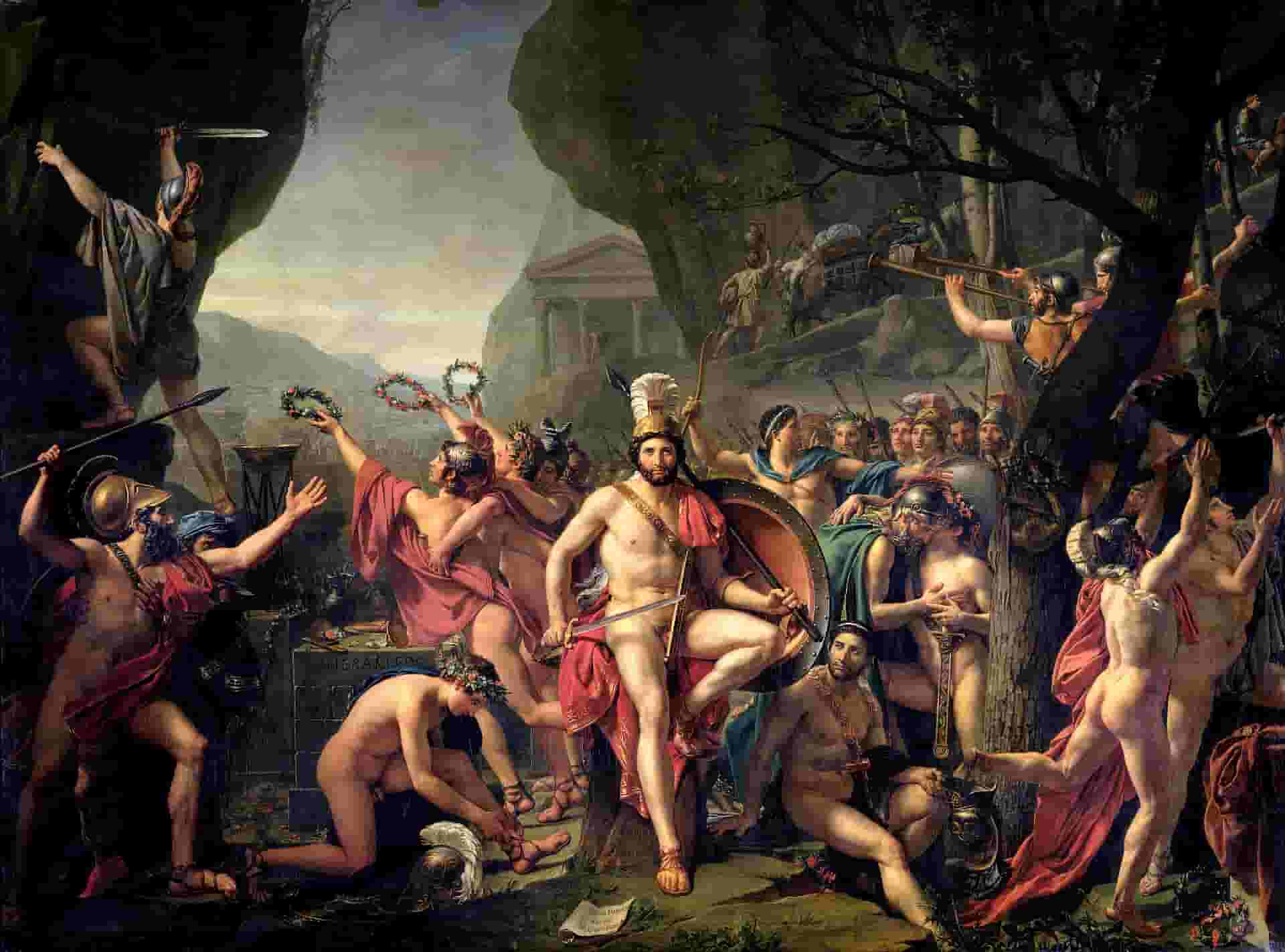
Persian scouts rode forward and, according to Herodotus, found the Spartans engaged in an activity that seemed bizarre: calmly combing and braiding their hair. To the scouts, this looked like casual indifference. To the Spartans, it was ritual. Spartan warriors groomed themselves before battle, especially when they expected to die.
When the scouts reported back, Xerxes reportedly laughed. A few thousand men at a narrow pass would not stop the King of Kings. He ordered the Greeks to lay down their arms. Leonidas answered in two words: “Molon labe”—“Come and take them.” And then Xerxes sent his army forward.
Day One: The Bronze Wall
The first waves of the Persian attack were made up of troops from the Medes and other subject peoples. They advanced into the pass, accustomed to their own ways of war—bows, lighter shields, shorter spears. At Thermopylae, nearly all those advantages disappeared. The mountain walls and shallow coastal ground forced them into dense formations, straight into the waiting Greek phalanx.
The clash was brutal and close. Persian arrows darkened the air; Greek shields absorbed the storm. Then the hoplites surged forward, spear points punching into the dense mass of troops. At this range, discipline was deadly. The Medes fought hard, but again and again they were forced back, leaving the narrow passage choked with bodies. Xerxes watched as his first assaults failed to clear a strip of land barely wide enough for a few dozen men abreast.
Day Two: The Immortals Tested
Humiliated by the performance of his frontline troops, Xerxes sent in his finest: the Immortals, a 10,000‑strong elite infantry corps, distinguished by their status as the king’s household force. The Immortals were better armored and better trained than most of the imperial host. They were expected to break what others could not.
But the pass did not care about their prestige. Leonidas rotated different Greek contingents to the front, keeping a fresh line of hoplites in the killing zone. The Immortals advanced, met the phalanx, and found themselves in the same nightmare: funneled into a narrow space, unable to bring their full numbers to bear, taking spear thrusts from a wall of bronze and wood they could not easily outflank.
The elite corps suffered heavy losses. Xerxes, according to some accounts, reportedly leapt from his throne three times in alarm during these first two days, watching his best men fail to secure what should have been a simple passage. Thermopylae was not becoming a disaster yet—but it was costing him far more blood than he expected.
The Unseen Route
Only one thing could break Thermopylae: not more men, but a different angle. Above the pass, along the slopes of Kallidromos, ran a lesser‑known track—the Anopaia path—winding through the hills and around the rear of the Greek position. The Greeks knew about it and posted roughly a thousand Phocians to guard it.
Then a man named Ephialtes appeared. Herodotus presents him as a Malian local who went to Xerxes and revealed the path for a reward. Whatever his motives—greed, fear, or personal grudges—his information gave the Persians what sheer force had failed to achieve: a way around the wall.
Night March in the Hills
Under cover of darkness, Xerxes sent a picked force under Hydarnes along the Anopaia path. They moved quietly through forest and ravine, guided by local knowledge. At dawn, as they neared the Phocians, the guards realized what was happening.
The Phocians took up a position on higher ground, ready to fight, but Hydarnes had no need to destroy them outright. He pushed them back and kept marching, slipping past them and continuing down toward the rear of Leonidas’ line. The trap was closing—not on the Persians, but on the Greeks.
News from the Mountain
When word reached Leonidas that Persian troops had turned his flank and were descending behind his position, the battle’s nature changed in an instant. The narrow pass that had been a fortress became a potential grave. If the defenders stayed where they were, they would be caught between the frontal assaults they had already endured and fresh Persian troops arriving from the rear.
Leonidas faced a ruthless calculation: hold the pass and lose the entire force, or withdraw the bulk of the army and leave a rearguard to buy a little more time with their lives.
The Choice to Dismiss and Stay
He chose the second option. Leonidas dismissed most of the allied contingents so they could retreat and continue the war elsewhere. Those who left included many of the central Greek forces needed for future campaigns.
But not everyone went. The 300 Spartans of Leonidas’ personal guard stayed as expected; this was their king, and this was the fight they had come for. Roughly 700 Thespians remained voluntarily, refusing to abandon the position. A contingent of Thebans stayed as well, though later sources debate whether they were willing participants or politically compelled. What had been an army holding a gate was now a small band committed to a last stand.
Into the Open
On the final day, Leonidas moved forward from the security of the Phocian Wall and fought in a wider section of the pass. This did two things: it allowed the defenders to meet more of the Persian attackers head‑on and gave them space to maneuver rather than be trapped directly behind the wall as the encirclement tightened. It also stripped away one more layer of protection. The last stand would be plain and visible, fought in open ground where both Xerxes’ men and the gods could see.
The fighting was savage. Spears splintered; swords took their place. When swords broke, men grappled, struck with shield rims, and used whatever they had left. Later Greek tradition, sharpening the legend, speaks of warriors fighting with hands and teeth when their weapons were gone—a symbol, if not a literal detail, of how far the defenders were willing to go.
Leonidas Falls
At some point in this maelstrom, Leonidas was struck down. The precise manner of his death is not clear in the sources, but Herodotus records that the struggle over his body became a focal point of the fighting. Spartans and other Greeks pushed forward again and again to recover their king’s corpse, forcing the Persians back temporarily.
Eventually, sheer numbers won. Hydarnes’ flanking force completed the encirclement; fresh Persian troops pressed in from behind while the battered formations in front closed ranks. The last Spartans and Thespians were surrounded. They died where they stood, fighting to the end. The Thebans, according to some accounts, surrendered in the final stage of the battle.
Desecration and Monuments
Thermopylae ended in a clear tactical result: Xerxes controlled the pass. His engineers and soldiers now secured the route south; the land barrier that had delayed the invasion was gone.
According to Herodotus, Xerxes ordered Leonidas’ head cut off and his body displayed, an act unusually harsh by Persian standards toward fallen enemies. Whether meant to terrorize the Greeks or satisfy royal anger, it marked the battlefield as a place of both valor and vengeance. Later, once the war had turned, the Greeks would return to raise their own monuments: a stone lion for Leonidas, markers listing the city‑states whose men fell there, and the famous epitaph of Simonides—“Stranger, tell the Lacedaemonians that we lie here, obedient to their words.”
The Road Opens—and Closes Again
With Thermopylae taken, Xerxes advanced. Athens evacuated on the advice of Themistocles; the city’s civilians withdrew to Salamis and other safe refuges while the fleet regrouped. Persian forces entered and burned much of Athens, including its temples. On land, the invasion seemed unstoppable.
But the war was never just about one pass. In the narrow straits off Salamis, the Greek fleet lured the larger Persian navy into cramped waters where its numerical advantage meant little. The resulting battle ended in a major Persian defeat. Concerned about the security of his fleet and the risk of being trapped in Greece without naval support, Xerxes withdrew most of his army to Asia, leaving Mardonius with a substantial force to continue the campaign.
The next year, at Plataea, a reinforced Greek army under the Spartan regent Pausanias met and defeated Mardonius’ troops decisively. The Persian invasion collapsed. Xerxes’ grand design—to crush Greece and erase the memory of Marathon—had failed.
A Defeat That Became a Legend
Measured coldly, Thermopylae was a defeat for the defenders. They died, the pass fell, and the enemy continued south. Yet the battle refused to remain a mere entry in a campaign log. It became a symbol: of a small coalition that used terrain to stand against a gigantic empire, of discipline that made numbers bleed, and of men who knew they would die but chose to stand anyway.
For later Greeks, Thermopylae stood alongside Salamis and Plataea as part of a story of survival. For later centuries, it became one of history’s archetypal “last stands,” studied for its tactics and remembered for its ethos. The Hot Gates were lost—but the time they bought helped ensure that Greece itself was not.
1. Fighting in the Shade
Herodotus also preserves a sharp exchange that became legendary among the Greeks. A local Greek reportedly visited the spartan camp day's before the battle and told them that their archers were so numerous that their arrows would “blot out the sun.” One of the Spartans—often identified in later tradition as Dienekes—replied: “Then we shall fight in the shade.” It was a bitter joke and a statement of intent all at once, showing that the hoplites at Thermopylae expected to face a rain of missiles in the narrow pass and were ready to keep fighting even when daylight itself disappeared behind the storm of Persian arrows.
The Ground
Where it was fought
Test yourself
Quiz
Question 1
Why did Xerxes decide to launch the massive invasion of Greece in 480 BCE?
Question 2
Why did the Greeks send only a vanguard to Thermopylae at first, instead of their full combined army?
Question 3
Which of the following units suffered heavy casualties when attacking the Greek position but failed to break through?
Question 4
The Persians won a clear tactical victory at Thermopylae but suffered significant casualties and delays that helped the Greeks later in the war.
Question 5
Leonidas kept his entire army at Thermopylae until the end; no Greek contingents were allowed to leave.
Question 6
Which local traitor revealed the mountain path to the Persians?
Question 7
Which weapon formation did Greek hoplites use in the narrow pass?
Explore more
You Might Also Like
Ranked by country match, then era, then how close the battles were in time.