Why Did William Win the Battle of Hastings? The 1066 Strategy Explained
England
William won the Battle of Hastings due to superior tactics, better army organization, and King Harold's critical mistakes—including his rushed march from Stamford Bridge and the breakdown of the English shield wall.
The Battle of Hastings (October 14, 1066) was a decisive Norman victory that established William, Duke of Normandy, as the ruler of England. What was William's strategy? William used combined-arms tactics, coordinating archers, infantry, and cavalry to break the English shield wall through repeated charges and feigned retreats that lured Anglo-Saxon troops from their defensive positions. How did Harold respond? King Harold Godwinson positioned his army on Senlac Hill in a strong defensive formation, but his forces were exhausted from marching 240 miles north to defeat Harald Hardrada at Stamford Bridge just weeks before. What was the outcome? After a full day of fighting, Harold was killed (traditionally said to be by an arrow through the eye), the English army collapsed, and William was crowned King of England on Christmas Day 1066, beginning the Norman Conquest.
Outcome
Norman Victory
Commanders
William, Duke of NormandyOverall commander of the Norman invasion force · Norman
Odo of BayeuxWilliam’s half‑brother, papal supporter and key leader in the Norman army · Norman
Alan the RedCommander of the Breton contingent in William’s army · Norman
Harold GodwinsonKing of England, overall commander of the English army · English
Gyrth GodwinsonHarold’s brother, ealdorman, fought and died at Hastings · English
Leofwine GodwinsonHarold’s brother, ealdorman, fought and died at Hastings · English
Forces engaged
Normanabout 7,000–12,000 men
Englishabout 5,000–13,000 men
Casualties
Normanaround 2,000
Englisharound 4,000–6,000
Region
East Sussex, England
Coordinates
50.914, 0.488
Chronicle
What happened
I
Chapter 1 of 5
Background
A Crown Without an Heir
On 5 January 1066, King Edward the Confessor died in his palace at Westminster, leaving behind a kingdom and a crisis. Edward had ruled England for twenty-four years, a pious and moderate king in an age of warlords and usurpers, but he had no child to succeed him. In Anglo-Saxon England, the throne was not automatically inherited; it was granted by the Witan, the council of great nobles and churchmen, who chose the man they believed could hold the realm together.
They chose Harold Godwinson. Earl of Wessex, brother-in-law to Edward, and the most powerful magnate in the kingdom, Harold was crowned the next day in Westminster Abbey — a rapid coronation meant to seal his legitimacy before any rival could act. To many in England, he was the obvious choice: a seasoned commander, a proven administrator, and a man who had effectively run the kingdom during Edward’s later years.
Across the Channel, one man disagreed.
The Duke’s Claim
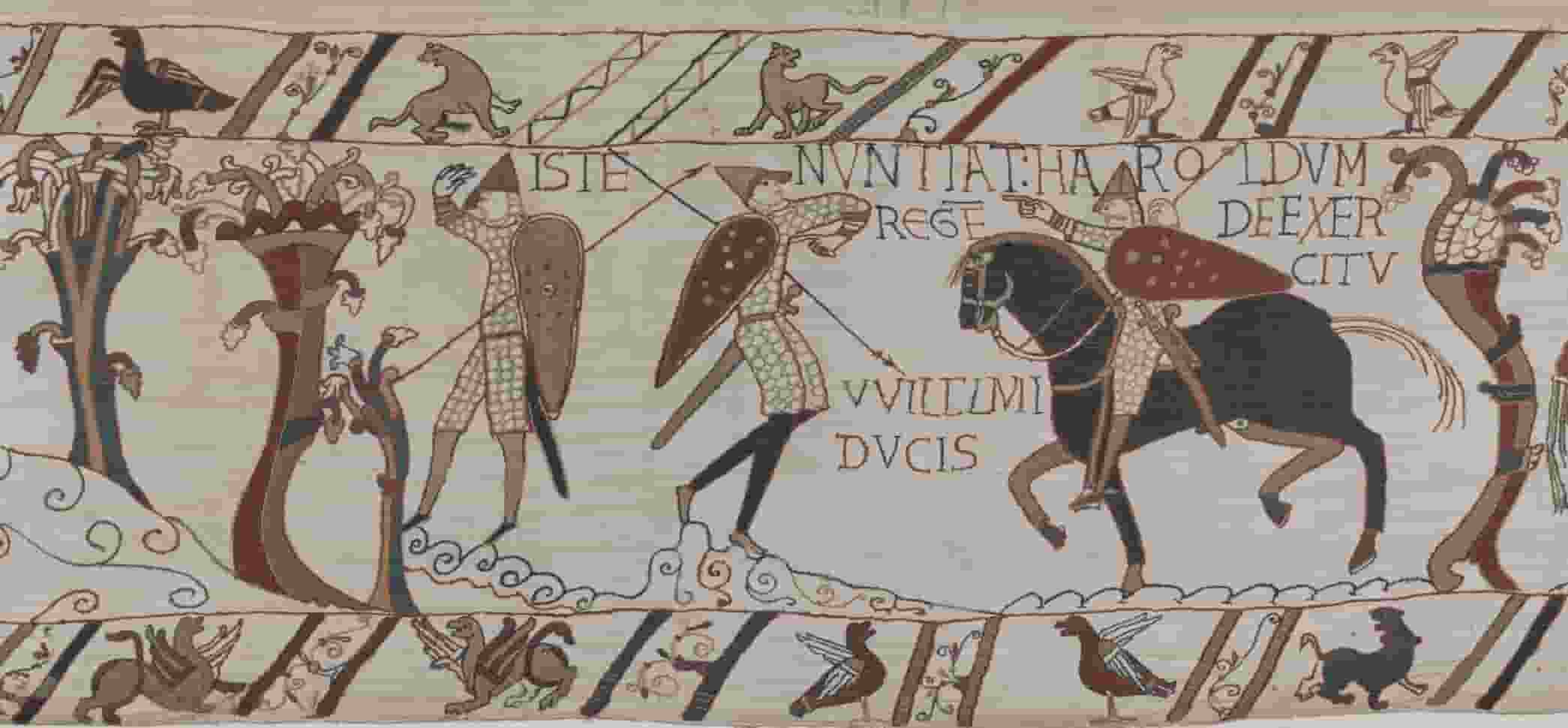
In Normandy, Duke William heard the news with fury. He claimed that Edward, his distant cousin, had promised him the English crown back in 1051, and that Harold himself had later sworn an oath — on holy relics, according to Norman propaganda — to support William’s claim. The Bayeux Tapestry would later show Harold kneeling before William, hand on a shrine, swearing fealty; English sources would later insist the oath was coerced, or never made at all.
To William, it did not matter. He had spent years building a powerful, disciplined duchy, forging alliances with Brittany, Flanders, and parts of France, and assembling a war machine capable of crossing the Channel. Now, with Edward dead and Harold crowned, he had his pretext: he would invade England, defeat the usurper, and take by force what he believed was rightfully his.
A Third Claimant from the North
There was a third player in this deadly game: Harald Hardrada, King of Norway. His claim rested on an old agreement between his predecessor and the earlier English king Harthacnut: if either died without an heir, the other would inherit both England and Norway. It was a thin claim by any measure, but Harald had the ships, the men, and the ambition to make it real.
He was joined by Harold Godwinson’s own brother, Tostig, exiled Earl of Northumbria, who saw in Harald a chance to reclaim his lost power. In early September 1066, a fleet of perhaps 300 Norwegian ships sailed into the Humber, joined by Tostig’s small squadron, and began to ravage the north. On 20 September, they defeated a northern English army at Fulford Gate, near York, and the city itself seemed ready to surrender.
Harold Godwinson could not be in two places at once. He had spent the summer waiting on the south coast for William’s invasion, but with harvest due and supplies running low, he had dismissed much of his army and fleet in early September. When news came of the Norwegian invasion, he marched north at forced speed, covering roughly 200 miles in under a week.
On 25 September, at Stamford Bridge, east of York, he caught the Norwegians by surprise. In a brutal, day-long fight, Harold’s housecarls — the elite core of his army, professional warriors in chainmail and helmets — smashed the Viking force. Harald Hardrada and Tostig were both killed; only a fraction of the Norwegian army survived to limp home.
It was a magnificent victory — and a catastrophic piece of timing. Three days later, on 28 September, William’s invasion fleet, delayed for weeks by unfavorable winds, finally crossed the Channel unopposed and landed at Pevensey, in Sussex. Harold’s army, exhausted and bloodied from the north, would have to turn around and march straight back south — straight into the teeth of a second, even more dangerous invasion.
Two Armies, One Ridge
By 13 October, Harold’s force — perhaps 7,000 men, a mix of housecarls and shire levies — had reached Caldbec Hill, about eight miles north of William’s fortified camp at Hastings. They took up position along the ridge of Senlac Hill, a low, hammer-head shaped rise protected on the flanks by woods and marshy ground, with a small stream at its base.
William, alerted by scouts, moved his army — also probably around 7,000 strong, but with a crucial difference — up from the south. His force was a combined-arms army: roughly half infantry, the rest split between cavalry and archers, including crossbowmen. Harold’s army was almost entirely infantry, with few archers and no cavalry at all.
At dawn on 14 October 1066, the two armies faced each other across a shallow valley. On one side stood the last true Anglo-Saxon king of England, defending a crown he had held for only nine months. On the other, a Norman duke who had staked everything on a single, audacious gamble.
What followed would be the most famous battle in English history — a single day of fighting that would end 500 years of Anglo-Saxon rule and reshape the language, law, and landscape of England forever.
Wikipedia – Battle of Hastings
Britannica – Battle of Hastings
World History Encyclopedia – Battle of Hastings
National Geographic – “This battle lasted just one day—but forever changed England”
English Heritage – What Happened at the Battle of Hastings
Wikipedia – Harald Hardrada & Stamford Bridge context
The Shield Wall Forms
At about 9 a.m. on 14 October 1066, the Battle of Hastings began with the blast of trumpets on both sides. Harold’s army stood atop Senlac Hill in a tight, dense formation, their shields locked together to form the famous Anglo-Saxon shield wall — a living barrier of wood, leather, and iron, bristling with spears, axes, and swords. At the center, around the royal standard, stood Harold’s housecarls, the best-trained and best-armored troops in the kingdom, many wielding the fearsome two-handed Danish battle-axe.
Below them, William arrayed his army in three divisions: Bretons on the left, Normans in the center under his direct command, and Frenchmen on the right. In front stood the archers and crossbowmen; behind them, the heavy infantry; and in reserve, the cavalry — armored knights on relatively light horses, carrying lances, swords, and maces.
Arrows and Axes
The battle opened with a volley of Norman arrows, loosed uphill into the English line. The angle was poor; many arrows bounced off the shields or sailed over the heads of the defenders entirely. The English, short on archers of their own, could not reply in kind; instead, they hurled spears, javelins, stones, and the occasional axe down the slope as the Norman infantry advanced.
The first Norman infantry assault met a wall of steel. As the attackers climbed the slope, they were battered by a hail of missiles and then smashed into by the housecarls’ great axes, which could cleave through shields, helmets, and mail alike. The Norman cavalry moved up in support, but the steep, scrubby ground hindered their charge, and they too were repulsed.
At one point, a cry rippled through the Norman left: the Duke had been killed. Panic spread; some Breton troops began to flee. Seeing the danger, William rode hard into the chaos, lifting his helmet to reveal his face and shouting that he was alive and would yet conquer. He rallied his men, then led a fierce counterattack against the English who had broken ranks to pursue the fleeing Bretons. On a small hillock below the main ridge, the isolated English were surrounded and cut down.
It was a warning: leave the shield wall, and you die. Yet the temptation to exploit a supposed rout would prove fatal.
The Long Afternoon
For hour after hour, the battle see-sawed. The Normans attacked, were thrown back, regrouped, and attacked again. William is said to have had three horses killed beneath him during the day, a sign of how close he fought to the front. The English line, though battered, held.
Then William tried something new. At least twice during the afternoon, Norman units made a feigned retreat — pretending to break and flee in panic. Some of the English, thinking they had finally cracked the invaders, left the safety of the ridge to chase them down the slope. Once on flatter ground, they lost the protection of the shield wall and were cut to pieces by the waiting cavalry.
It did not shatter the English line outright, but it thinned it — especially among the housecarls, who were hardest to replace. As the day wore on, gaps began to appear.
The King Falls
Late in the afternoon, as the autumn light began to fade, the Normans launched another heavy assault. By now, Harold’s brothers Gyrth and Leofwine were almost certainly dead, and the English command structure was fraying. Then came the moment that decided the battle: King Harold himself was killed.
How exactly he died is still debated. The Bayeux Tapestry shows a figure with an arrow in his eye, alongside another being struck down by a sword; the inscription above reads, “Here King Harold has been killed.” Later chroniclers tell of an arrow piercing his eye, then of Norman knights hacking him to pieces as he fell. Some sources claim William himself struck the fatal blow; others say no one knew who killed the king in the press of battle.
What is certain is the effect: with Harold dead, the English army lost its head. The housecarls gathered around his body and fought to the last, but the rest of the line began to crumble.
The Last Stand at the Malfosse
As dusk fell, the English broke and fled. The Normans pursued relentlessly, cutting down stragglers across the valley. A remnant of the English army made a final stand at a place later called the Malfosse — the “Evil Ditch” — a small fortification or set of earthworks where they rallied and inflicted heavy losses, wounding even Eustace of Boulogne, one of William’s closest companions.
But by then the battle was over. Night fell on a field strewn with the dead and dying, and on a kingdom that had just changed hands in a single day.
Wikipedia – Battle of Hastings
Britannica – Battle of Hastings
World History Encyclopedia – Battle of Hastings
National Geographic – “This battle lasted just one day—but forever changed England”
English Heritage – What Happened at the Battle of Hastings
Wikipedia – Harald Hardrada & Stamford Bridge context
The North Before the South
The first turning point came before Hastings was even fought. Harold’s decision to march north and confront Harald Hardrada at Stamford Bridge on 25 September saved his kingdom from a Viking conquest — but it left his army exhausted and far from the south just as William landed. The speed of his march — roughly 200 miles in under a week — was a feat of logistics and leadership, but it meant his men reached Sussex battle-weary and without the full levy of the southern shires.
Had William landed in August as first planned, or had Harold waited longer to gather more troops after Stamford Bridge, the battle might never have been fought on that ground, or with that army.
The Feigned Retreat
The second turning point was tactical: the Norman use of feigned retreats. In an age when many battles were decided within an hour, the English shield wall held for nine. The only way to break it was to lure part of it off the hill.
When William’s troops pretended to flee in panic, some English — perhaps led by Harold’s brothers — broke ranks to pursue. On the lower ground, they were cut down by cavalry. Repeated twice, this tactic gradually eroded the core of the English defense, the housecarls, and opened gaps that the Normans could exploit.
The Death of the King
The third, and decisive, turning point was Harold’s death. In a battle where command was personal and visible, the loss of the king was catastrophic. With no clear successor on the field, the English army fractured: some fought on around Harold’s body; others fled.
Once the shield wall dissolved, the Norman cavalry — held back all day for precisely this moment — could finally operate as intended, running down the scattered English and turning a hard-fought contest into a rout.
Wikipedia – Battle of Hastings
Britannica – Battle of Hastings
World History Encyclopedia – Battle of Hastings
National Geographic – “This battle lasted just one day—but forever changed England”
English Heritage – What Happened at the Battle of Hastings
Wikipedia – Harald Hardrada & Stamford Bridge context
A New Dynasty Begins
On 25 December 1066, less than three months after the battle, William was crowned King William I of England in Westminster Abbey. The last Anglo-Saxon king was dead; the era of Norman rule had begun.
William’s victory at Hastings did not end the war; it began a five-year campaign of conquest and consolidation. Rebellions flared in Exeter, the north, and the east; Harold’s sons launched invasions from Ireland; Danish fleets intervened in support of English rebels. William responded with ruthless efficiency, culminating in the “Harrying of the North” in 1069–70, a scorched-earth campaign that devastated large parts of Yorkshire and beyond.
A Transformed Kingdom
The consequences of Hastings reached far beyond the battlefield. Within a generation, the Anglo-Saxon aristocracy had been almost entirely replaced by a Norman elite; the Domesday Book of 1086 would record that barely five percent of land remained in English hands. Castles — virtually unknown in pre-Conquest England — sprang up across the country, from the Tower of London to Durham, Rochester, and Norwich, anchoring Norman control.
The Church was restructured, with Norman bishops and abbots installed in key sees; the English language was pushed out of official use, supplanted by Latin and Anglo-Norman French. Words like judge, jury, and evidence entered English via this new legal and administrative order, leaving a linguistic imprint that remains visible today.
The Field of the Dead
On the battlefield itself, William founded Battle Abbey, traditionally said to be built in penance for the bloodshed, with its high altar placed — according to later tradition — on the spot where Harold’s body was found. Harold’s own burial remains a mystery: some stories claim his mother offered William the king’s weight in gold for his body; others say he was buried at Waltham Abbey, or even that he survived and lived as a hermit.
Casualty figures are uncertain, but modern estimates suggest perhaps 2,000 Norman and 4,000 English dead — staggering losses for a single day’s fighting in the eleventh century. The Bayeux Tapestry, embroidered within a generation of the battle, would immortalize the story from the Norman perspective, showing Harold’s death and the collapse of the old order.
In the end, Hastings was more than a battle; it was a hinge of history. It ended five centuries of Anglo-Saxon rule and tied England’s fate to the Continent for centuries to come — a single day on a Sussex ridge that changed the course of a nation.
Wikipedia – Battle of Hastings
Britannica – Battle of Hastings
World History Encyclopedia – Battle of Hastings
National Geographic – “This battle lasted just one day—but forever changed England”
English Heritage – What Happened at the Battle of Hastings
Wikipedia – Harald Hardrada & Stamford Bridge context
1. The Bayeux Tapestry Is more then a tapestry
The famous Bayeux Tapestry is actually an embroidered linen cloth, not a woven tapestry. At around 70 metres long, it tells the story of William’s invasion and the Battle of Hastings through pictures and Latin captions. It was probably made soon after the conquest, possibly by English embroiderers, and remains one of the most important surviving sources for 1066
2. William’s Invasion Carried a Papal Banner
The Normans entered the Battle of Hastings beneath a cross-shaped banner, reportedly blessed and sent to William by Pope Alexander II. It appeared twice in the Bayeux Tapestry and gave William’s invasion the authority of the Church.
William had presented Harold as an oath-breaker and promised to reform England’s church if he won. With the papal banner above them, Norman soldiers could see the invasion not as an ordinary war, but as a cause supported by St Peter himself.
English Heritage — Papal Banner
Reading Museum — The History of Britain’s Bayeux Tapestry
The Ground
Where it was fought
Test yourself
Quiz
Question 1
Harold was crowned the day after Edward died.
Question 2
Roughly how many miles did Harold march north in under a week?
Question 3
When Harrold died the Anglo Saxon rule over Brittain ended
Question 4
What alliances had William built to prepare his invasion force?
Question 5
Why had Harold dismissed much of his army and fleet in early September?
Question 6
What tactic thinned the English shield wall in the afternoon?
Explore more
You Might Also Like
Ranked by country match, then era, then how close the battles were in time.