The Battle of Stalingrad (July 17, 1942 - February 2, 1943) was a decisive Soviet victory on the Eastern Front of World War II. How did the Soviets win? The Red Army first used determined urban resistance to hold the Germans in the ruins of Stalingrad, where close-quarter fighting weakened Friedrich Paulus’s Sixth Army and limited the effectiveness of German tanks and air power. On November 19, 1942, the Soviets launched Operation Uranus against the weaker Romanian forces protecting the German flanks. The two Soviet pincers met west of the city on November 23, surrounding roughly 250,000–300,000 Axis troops. Hitler refused to allow a breakout and relied on an inadequate Luftwaffe airlift, while a German relief attempt under Erich von Manstein failed. Cut off from food, ammunition, fuel, and medical supplies, the surrounded army weakened until the Red Army launched Operation Ring on January 10, 1943. Paulus surrendered on January 31, and the remaining German forces capitulated on February 2. Paulus surrendered on January 31, and the remaining German forces capitulated on February 2, 1943. The defeat destroyed Germany’s Sixth Army, ended its strategic advance in the Soviet Union and shifted the initiative on the Eastern Front to the Red Army.
Outcome
Soviet victory
Commanders
Georgy ZhukovStavka coordinator, Operation Uranus · Soviet Union
Vasily ChuikovCity defence commander · Soviet Union
Friedrich Paulus6th Army commander · Axis
Erich von MansteinArmy Group Don commander, led relief attempt · Axis
Forces engaged
Axis GunsAbout 10,000
Axis TanksMore than 640
Axis TotalAbout 1,000,000
Soviet GunsAbout 13,500
Soviet TanksAbout 900
Soviet TotalAbout 1,100,000
Casualties
Axis TotalAbout 800,000–1,500,000
Soviet TotalAbout 1,130,000
Axis CapturedAbout 235,000
Soviet Wounded or SickAbout 651,000
Soviet Killed or MissingAbout 479,000
Region
Volgograd Oblast
Coordinates
48.700, 44.516
Chronicle
What happened
I
Chapter 1 of 5
Background
The Road to the Volga
By the summer of 1942, Nazi Germany had failed to defeat the Soviet Union in a single campaign. Operation Barbarossa had carried German armies deep into Soviet territory in 1941, but Moscow had held, and the German advance had stalled in the winter.
Hitler’s answer was a new southern offensive: Fall Blau. Its main strategic goal was not originally Stalingrad itself. Germany needed oil. The oil fields of the Caucasus especially around Maikop, Grozny and Baku were vital to the Soviet war effort and desperately desired by the German army, which was chronically short of fuel. Stalingrad mattered because it stood on the Volga, the great river artery along which oil from the Caucasus and the Caspian was shipped north into central Russia. Taking the city could cut Soviet transport, protect the northern flank of the drive into the Caucasus, and bring Hitler an enormous propaganda victory by capturing the city that carried Stalin’s name.
On 28 June 1942, Heeresgruppe Süd began its offensive into southern Russia. At first, the Germans advanced quickly across the steppe. Then, as planned Heeresgruppe Süd was split into two separate commands and Hitler's decision to pursue both objectives at once shaped the entire campaign: he split Heeresgruppe Süd into two separate commands. Army Group A would drive into the Caucasus while Army Group B including General Friedrich Paulus’s Sixth Army would move toward Stalingrad and the Volga to protect the northern flank and have Group A's back.
The decision gave Germany two enormous objectives at once, but not enough resources to secure both properly. Supply lines stretched hundreds of kilometres across poor roads and railways. German forces were divided between the Caucasus and Stalingrad. Most dangerously, the long flanks of the advance were handed to Romanian, Italian and Hungarian army forces that often lacked modern anti-tank weapons, transport and reserves.
A City That Could Not Be Given Up
Stalingrad was an industrial city stretching for roughly 50 kilometres along the west bank of the Volga River. It produced tractors, weapons and armoured vehicles. Its factories could be turned into fortresses. Its long, narrow shape meant that an attacker could seize much of the city and still fail to drive the defenders into the river.
For Stalin the city had both military and symbolic value. On 28 July 1942 he issued Order No. 227: “Not one step back.” The phrase became linked with the defence of Stalingrad but was carried out to the entire Red Army, although the battle would still involve retreats, counterattacks and enormous losses.
On 23 August, German forces reached the northern outskirts, and the Luftwaffe bombed the city with devastating force. Much of Stalingrad was reduced to rubble. Thousands of civilians were killed and those who remained were trapped inside a battlefield that was becoming almost impossible to survive.
The bombing was meant to break Soviet resistance.
Instead, it created a city of ruins in which tanks struggled to move, artillery could not always see its targets, and small Soviet units could hide, ambush, and fight from every basement, sewer, factory and shattered wall.
By September, General Vasily Chuikov had taken command of the Soviet 62nd Army inside the city. His task was simple to state and almost impossible to carry out: hold the western bank of the Volga.
The battle for Stalingrad had begun.
Britannica — Battle of Stalingrad
National WWII Museum — Stalingrad: Experimentation, Adaptation, Implementation
Netflix documentary's
Sarah Rombout - geschiedenisles
imperial war museum - visit
Encyclopaedia Britannica — Timeline of the Battle of Stalingrad
United States Holocaust Memorial Museum — German Defeat at Stalingrad.
The City Becomes a Battlefield
In September 1942, the German Sixth Army entered Stalingrad from the west while elements of Hermann Hoth’s Fourth Panzer Army threatened it from the south. Paulus believed the city could be taken in days. Instead every advance into the ruins became a separate battle.
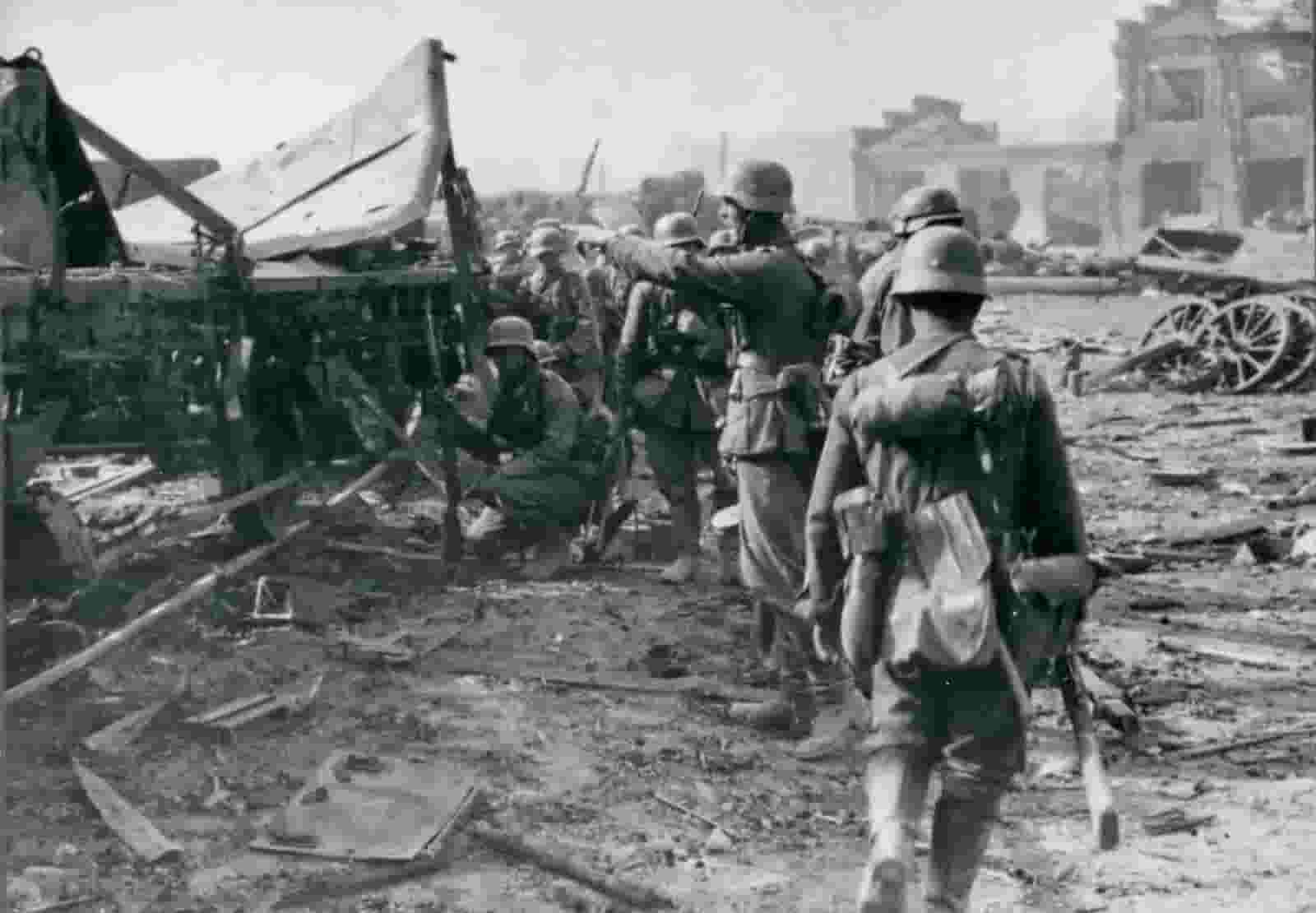
The Germans captured streets, buildings, railway stations, warehouses and parts of the great factory districts. But Soviet defenders remained behind them, below them, or only a few metres away. A German unit might clear one floor of a building and discover that Soviet soldiers still held the basement. A captured factory hall could become useless if snipers controlled the windows, stairways, or roof.
The Germans called this kind of combat Rattenkrieg “rat war.” It was a war of short distances, grenades, machine guns, flamethrowers, and sudden attacks through rubble. Soviet troops deliberately fought close to German positions whenever possible. This reduced the effect of German artillery and air power because heavy bombardment risked hitting German soldiers as well.
The central places in the fighting became symbols of the battle: the grain elevator, the railway station, Mamayev Kurgan hill, the Red October factory, the Barrikady factory and the Tractor Factory. The names mattered less than the pattern. Every position was fought over until one side was exhausted, then fought over again.
The Volga Behind Them
By October the Soviet defenders had been pushed back to a narrow strip along the river. In some places, they held only a few hundred metres of ground between the German lines and the Volga.
The river was their lifeline.
At night, boats and barges brought ammunition, food and reinforcements across from the eastern bank. They carried wounded men back when they could. German artillery and aircraft targeted the crossings and many soldiers died before even reaching the city. But the supplies continued to come.
Chuikov divided his defence into small assault groups, often only dozens of men strong. These units operated with unusual independence. They learned the ruins, used cellars and sewer lines, and counterattacked whenever German troops became separated from their support.
The German army captured most of Stalingrad. By November it controlled roughly 90 percent of the ruined city.
But could it capture all of it?
That remaining strip of Soviet-held ground was holding on.
The Soviet Plan
While the German Sixth Army was being consumed in street fighting, Soviet commanders were preparing a far larger operation outside the city.
Marshal Georgy Zhukov and General Aleksandr Vasilevsky understood that attacking the German troops inside Stalingrad directly would be extremely costly. The Sixth Army was experienced, heavily armed, and hardened by months of fighting.
So the Soviets chose a different target: the Axis flanks.
North and south of Stalingrad, the German advance was protected largely by Romanian armies. These troops were spread thinly across open steppe, short of anti-tank weapons, and unable to match a major Soviet armoured attack. The German high command knew the flanks were vulnerable but it did not have enough mobile reserves to strengthen them properly.
The Soviet plan was called Operation Uranus.
It would not try to push the Germans out of Stalingrad street by street. It would surround them.
Operation Uranus
On 19 November 1942, in snow and freezing weather Soviet artillery opened fire north of Stalingrad. The next day a second Soviet attack began south of the city.
The northern attack struck the Romanian Third Army. The southern attack hit the Romanian Fourth Army. The Romanian soldiers fought hard but their lines could not stop the Soviet tanks and infantry. Within hours the defensive front began to collapse.
The Soviet forces did not stop to fight every isolated position. They drove through the gaps moving west behind the German Sixth Army.
On 23 November the two Soviet pincers met near Kalach about 80 kilometres west of Stalingrad. The encirclement was complete.
Around 250,000–300,000 German, Romanian, and other Axis troops were trapped in what the Germans called the Kessel, the cauldron.
The German army that had nearly taken Stalingrad was now cut off from the rest of the front.
The Airlift Fails
Paulus asked for permission to break out toward the west while the encirclement was still forming. Hitler refused. He ordered the Sixth Army to hold its position and promised that the Luftwaffe would supply it by air.
The promise was impossible to keep.
The trapped army needed hundreds of tons of food, fuel, ammunition and medical supplies every day. The Luftwaffe could deliver only a fraction of that amount usually far less than the minimum required. Bad weather, Soviet fighters, anti-aircraft fire and the lack of suitable transport aircraft made the situation worse.
At first, the Sixth Army still had food and ammunition. But every week reduced its strength. Horses were slaughtered for meat. Wounded soldiers could not be evacuated. Frostbite, disease, hunger and exhaustion spread through the pocket.
The Germans were no longer fighting to capture Stalingrad.
They were fighting to stay alive inside it.
Winter Storm
In December, Field Marshal Erich von Manstein launched Operation Winter Storm, an attempt to reach the trapped army from the southwest.
The relief force advanced to within roughly 50 kilometres of the pocket. It was close enough that the distant sound of artillery could be heard by soldiers inside Stalingrad.
But the relief force could not reach the city on its own. It needed Paulus to break out and meet it.
Hitler again refused to allow the Sixth Army to abandon Stalingrad. Paulus did not disobey the order. The trapped army stayed in place while Manstein’s attack stalled.
Then the Soviets launched Operation Little Saturn against Axis troops farther west. This threatened Manstein’s own flanks and forced him to withdraw his relief force.
The last realistic chance to save the Sixth Army was gone.
The End of the Sixth Army
On 10 January 1943, the Soviet Army began Operation Ring, the final attack on the encircled German forces. Thousands of guns, mortars and rocket launchers bombarded the pocket before Soviet infantry and tanks moved forward.
The German perimeter shrank day after day.
The airfields at Pitomnik and Gumrak fell, ending meaningful air supply and evacuation. The wounded were left behind. Food became almost nonexistent. Soldiers burned furniture and wooden buildings for warmth. Many no longer had the strength to fight.
On 30 January, Hitler promoted Paulus to field marshal. The message was clear: no German field marshal had ever surrendered, and Hitler expected Paulus to die rather than be captured (learn more on Fun Facts tab).
Paulus surrendered the southern part of the pocket on 31 January.
The remaining German forces in the north surrendered on 2 February 1943. About 91,000 Axis soldiers went into Soviet captivity.
The battle was over.
Britannica — Battle of Stalingrad
National WWII Museum — Stalingrad: Experimentation, Adaptation, Implementation
Netflix documentary's
Sarah Rombout - geschiedenisles
imperial war museum - visit
Encyclopaedia Britannica — Timeline of the Battle of Stalingrad
United States Holocaust Memorial Museum — German Defeat at Stalingrad.
Germany Divides Its Strength
The first turning point came before the street fighting began.
Fall Blau had been ambitious even before Hitler split Army Group South. Once the German advance was divided between the Caucasus and Stalingrad, the offensive lost concentration. Supply lines became overstretched, reserves were limited and the flanks of the advance had to be held by Germany’s weaker allies.
This did not make German defeat inevitable. But it created the conditions in which one local failure could become a strategic disaster.
The City Does Not Fall
The second turning point was the Soviet defence inside Stalingrad.
German forces took most of the city, but the Soviet 62nd Army held the remaining strip beside the Volga. That small area allowed reinforcements and supplies to continue crossing the river while Soviet troops kept forcing the Germans into costly close-range combat.
The city did not have to be fully held to be useful. It only had to remain contested long enough for the Soviet counteroffensive outside it to be ready.
Uranus Hits the Flanks
The decisive turning point was Operation Uranus.
Instead of attacking the strongest German troops in Stalingrad, the Soviets attacked the Romanian armies guarding the long northern and southern flanks. The Romanian lines broke, Soviet tank formations pushed through and the pincers joined at Kalach.
The battle stopped being a fight for a city.
It became a fight to save an entire German army.
Hitler Forbids a Breakout
The final turning point was Hitler’s refusal to allow the Sixth Army to break out.
The Luftwaffe could not supply the trapped force. Manstein’s relief attack could not reach it alone. A breakout was dangerous and historians still debate whether it could have succeeded but it was their best chance of escape.
By ordering Paulus to hold Stalingrad, Hitler turned an encirclement into a destruction.
Britannica — Battle of Stalingrad
National WWII Museum — Stalingrad: Experimentation, Adaptation, Implementation
Netflix documentary's
Sarah Rombout - geschiedenisles
imperial war museum - visit
Encyclopaedia Britannica — Timeline of the Battle of Stalingrad
United States Holocaust Memorial Museum — German Defeat at Stalingrad.
An Army Is Lost
The surrender at Stalingrad destroyed the German Sixth Army and inflicted huge losses on Germany and its allies. Around 91,000 soldiers surrendered at the end of the battle, but only about 5,000–6,000 of them eventually returned home after Soviet captivity.
Total casualty figures vary because the battle included months of fighting in the city, the encirclement, the attempts to relieve it, and operations against Axis armies across southern Russia. A widely used estimate puts Axis casualties at roughly 800,000 to 1,500,000, while Soviet military casualties exceeded 1.1 million. Tens of thousands of civilians were killed during the battle, especially in the bombing and destruction of the city.
Stalingrad was not only a military defeat. It was a human catastrophe on a scale almost impossible to understand.
The Caucasus Is Abandoned
The defeat also forced Germany to abandon its wider southern strategy.
The German Army Group A had advanced deep into the Caucasus in search of oil. But after the encirclement at Stalingrad, its position became dangerous. If Soviet armies reached Rostov (the gateway to the Caucasus), they could cut off the entire German force in the Caucasus.
Germany therefore withdrew from the Caucasus in the winter of 1942–43. The original purpose of Case Blue (gaining Soviet oil and crippling the Soviet war economy) had failed completely.
The War Turns Eastward
Stalingrad did not end the war, and Germany still had the ability to launch major attacks. The German counterstroke at Kharkov in early 1943 showed that the Wehrmacht remained dangerous.
But Stalingrad changed the direction of the war. Germany had lost an entire army, its allies had been badly weakened, and the Soviet Union had shown that it could plan and carry out a huge, coordinated encirclement offensive.
After Stalingrad, the Red Army increasingly held the strategic initiative. Germany would attempt one more great offensive at Kursk in July 1943. When that failed, German armies on the Eastern Front would spend the rest of the war largely retreating westward.
A City Rebuilt from Ruins
Stalingrad was almost completely destroyed. Its factories, homes, railway stations, docks, and streets had been turned into rubble. The people who survived returned to a landscape of ruins, graves, unexploded shells, and burned-out buildings.
The Soviet Union rebuilt the city after the war. In 1945, Stalingrad was named a Hero City for its defence. On Mamayev Kurgan, one of the battlefield’s most contested heights, the enormous memorial statue The Motherland Calls was completed in 1967.
Today, the city is called Volgograd. But the name Stalingrad remains one of the strongest symbols of the Second World War: a city where German expansion reached its limit, a Soviet army survived against the odds, and the war in the east began to turn.
Britannica — Battle of Stalingrad
National WWII Museum — Stalingrad: Experimentation, Adaptation, Implementation
Netflix documentary's
Sarah Rombout - geschiedenisles
imperial war museum - visit
Encyclopaedia Britannica — Timeline of the Battle of Stalingrad
United States Holocaust Memorial Museum — German Defeat at Stalingrad.
The Promotion That Was Really a Message
On 30 January 1943, as the Sixth Army collapsed inside Stalingrad, Hitler promoted its commander, Friedrich Paulus, to field marshal, Germany’s highest army rank. It looked like an honour, but it was meant as pressure.
Hitler pointed out that no German or Prussian field marshal had ever been captured alive. The implication was that Paulus should fight to the death or commit suicide rather than surrender. Paulus refused to do either. The next day, 31 January, he surrendered to the Soviet Army in the southern part of the pocket, becoming the first German field marshal taken prisoner.
wikipedia - Friedrich Paulus
The Ground
Where it was fought
Explore more
You Might Also Like
Ranked by country match, then era, then how close the battles were in time.