How Did Japan Lose Midway? The 1942 Japanese Defeat Explained
United States of America
Japan lost the Battle of Midway due to broken code intelligence, overextended naval forces, and a decisive surprise attack that crippled their fleet.
The Imperial Japanese Navy launched an operation against Midway Atoll aiming to draw out and destroy the U.S. Pacific Fleet, but divided their forces across too vast an area. American codebreakers intercepted and decrypted Japan's plans, allowing U.S. forces to set an ambush instead. During the battle, Japanese carriers were caught off guard with flight decks cluttered with fuel and munitions while attempting to rearm their aircraft. American dive bombers struck three Japanese fleet carriers in a span of five minutes, followed by a fourth later that afternoon. Stripped of their core carrier force, the Japanese were forced to retreat, losing their strategic advantage and permanently turning the tide of the Pacific War in favor of the Allies.
Outcome
American Victory
Commanders
Chester NimitzOverall commander · United States
Frank FletcherCarrier force commander · United States
Raymond SpruanceCarrier force commander · United States
Isoroku YamamotoOverall commander · Japan
Chuichi NagumoCarrier force commander · Japan
Forces engaged
Japan4 fleet carriers and about 250 carrier aircraft
United States3 fleet carriers and about 360 aircraft
Casualties
Japanabout 3,057 killed; 4 fleet carriers and 1 heavy cruiser sunk
United Statesabout 307 killed; 1 carrier and 1 destroyer sunk
Region
Central North Pacific Ocean region
Coordinates
30.000, -178.000
Chronicle
What happened
I
Chapter 1 of 5
Background
A Trap Set in the Pacific
Six months after Pearl Harbor, the Imperial Japanese Navy ruled the Pacific. Their carrier strike force—the Kido Butai—had swept across Southeast Asia and the western Pacific with terrifying speed, sinking warships, overrunning islands, and humiliating the Allies at every turn. By May 1942, Japan's defensive perimeter stretched deep into the South Pacific as far as New Guinea, with an operation already planned to extend it north to the Aleutians and Tokyo's planners were already looking further east. The next target on their list was a tiny, barren atoll called Midway—two small islands sitting just 1,300 miles (about 2100 km) northeast of Pearl Harbor. To the Japanese, Midway was more than a speck of coral: it was a forward base that could threaten Hawaii itself, and a bait to draw out what remained of the U.S. Pacific Fleet's carrier force for a final, decisive battle.
Admiral Isoroku Yamamoto, mastermind behind Pearl Harbor and commander of the Combined Fleet, staked everything on this plan. His primary goal was not Midway itself, but the destruction of America's aircraft carriers—the only force that could challenge Japanese naval supremacy. The Doolittle Raid of 18 April 1942, in which sixteen U.S. Army bombers launched from the carrier Hornet struck Tokyo and other Japanese cities, had shattered Japan’s sense of invulnerability. This daring psychological blow humiliated the Japanese high command and silenced all internal opposition to Yamamoto's strategy. If the U.S. carriers could be lured out and annihilated, Japan could secure its perimeter, force a negotiated peace, and buy time to consolidate its conquests. Yamamoto assembled an armada of over 180 ships, including four fleet carriers—Akagi, Kaga, Soryu, and Hiryu—under Vice Admiral Chuichi Nagumo, backed by a massive invasion force and a distant battleship group commanded by Yamamoto himself.
The Americans Prepare an Ambush
On the American side, Admiral Chester W. Nimitz, commander of the Pacific Fleet, faced a desperate situation. The U.S. Navy had only three carriers available—Enterprise, Hornet, and Yorktown which was still badly damaged from the Battle of the Coral Sea just a month earlier. Outnumbered and outgunned, Nimitz's only hope lay in intelligence. At Pearl Harbor, in a cramped basement known as "Station HYPO," Commander Joseph Rochefort and his team of cryptanalysts had been working around the clock to break the Japanese Navy's primary operational code, JN-25. By late May, they had deciphered enough messages to confirm that Japan was planning a major operation against a target codenamed "AF." Rochefort was convinced "AF" meant Midway; Washington disagreed, suspecting the Aleutians or even Port Moresby. To prove it, Rochefort arranged for Midway to send a fake radio message reporting a freshwater shortage. The Japanese intercepted it and soon broadcast that "AF" was short on water. The trap was confirmed.
Nimitz gambled everything on Rochefort's intelligence. He ordered Task Force 16 (Enterprise and Hornet, under Rear Admiral Raymond Spruance) and Task Force 17 (Yorktown, under Rear Admiral Frank Jack Fletcher) to steam northwest of Midway and wait. The plan was simple: let the Japanese strike Midway first, draw their carriers into a vulnerable position, then hit them with everything the U.S. had. It was a desperate gamble—if the intelligence was wrong, or if the timing was off by even a few hours, the Pacific Fleet would be wiped out.
Midway Braces for Impact
On Midway itself, the atoll's defenders knew an attack was coming, but not when or how hard. The island was garrisoned by U.S. Marine and Army units, with a mix of fighter aircraft, bombers, and patrol planes. By early June, over 3,500 American servicemen were dug in on Eastern and Sand Islands (2 islands that make up Midway Atoll) backed by coastal artillery, anti-aircraft guns, and a network of trenches and bunkers. The American' aircraft included obsolete Brewster F2A Buffalos and Grumman F4F Wildcats, along with Douglas SBD Dauntless dive bombers and Martin B-26 Marauders. They were outnumbered and outclassed by the Japanese carrier air groups, but they had one advantage: they were fighting on home ground, and they knew that if Midway fell, Hawaii would be next.
Britannica: Battle of Midway summary and timeline
Wikipedia: Battle of Midway and order of battle
The Second World War.org: Midway battle summary
StationHypo.com: How codebreakers helped secure U.S. victory
National WWII Museum: Battle of Midway articles and casualty figures
Immf-midway.com: Losses in the Battle of Midway (PDF)
U.S. Navy History and Heritage Command: Battle of Midway overview and timeline
Midway. Directed by Roland Emmerich, performances by Ed Skrein, Patrick Wilson, and Woody Harrelson, Lionsgate, 2019.
Dawn — The First Strike
At 04:30 on 4 June, under a clear tropical sky, the decks of Nagumo's four carriers erupted with activity. One hundred and eight aircraft—fighters, dive bombers, and torpedo bombers—roared off the flight decks and headed southeast toward Midway. Their mission: soften up the atoll's defenses ahead of a planned amphibious invasion. At 06:30, the Japanese strike hit Midway hard. Bombs rained down on runways, hangars, and fuel depots. The island's fighters scrambled to intercept, but the Brewster Buffalos were outclassed by the Japanese Zeros. Within twenty minutes, the attack was over. Midway's airfield was damaged but still operational. The Japanese strike leader radioed Nagumo: a second strike would be needed to finish the job
Morning — Nagumo's Dilemma
Back on the Japanese carriers, Nagumo's whole plan rested on one assumption: the American carriers were still at Pearl Harbor, no threat yet. So at 07:15, with only Midway's defenses to worry about, he ordered the reserve aircraft — loaded with torpedoes since before dawn — stripped and rearmed with bombs. Deck crews had barely started when, at 07:28, a scout plane broke radio silence: enemy ships sighted to the northeast. No sign of a carrier yet, but Nagumo couldn't take the chance. At 07:40 he reversed the order again — halt the bombs, reattach the torpedoes.
Now his hangar decks were chaos: some planes stripped bare, others half-loaded, bombs and torpedoes stacked together in the open as crews scrambled to undo their own work. It wasn't until nearly an hour after that first sighting, around 08:20, that a second report confirmed what he'd feared — a carrier was out there. By then his flight decks were a logjam of half-armed planes, with no clean way out. The delay was fatal.
Mid-Morning — The American Torpedo Squadrons Attack
Between 09:20 and 10:20, U.S. carrier-based torpedo squadrons launched a series of uncoordinated attacks on Nagumo's fleet. First came the Hornet's Torpedo Squadron 8 (VT-8), followed by Enterprise's VT-6 and Yorktown's VT-3. Flying obsolete TBD Devastators at low altitude and slow speed, they were easy targets for the Japanese Combat Air Patrol. One by one, the American torpedo planes were shot down. Of the 41 Devastators that attacked, only six returned. Not a single torpedo hit its target. It was a slaughter—but it drew the Japanese fighters down to sea level, leaving the carriers' upper decks exposed.
10:22 — The Five Minutes That Changed the War
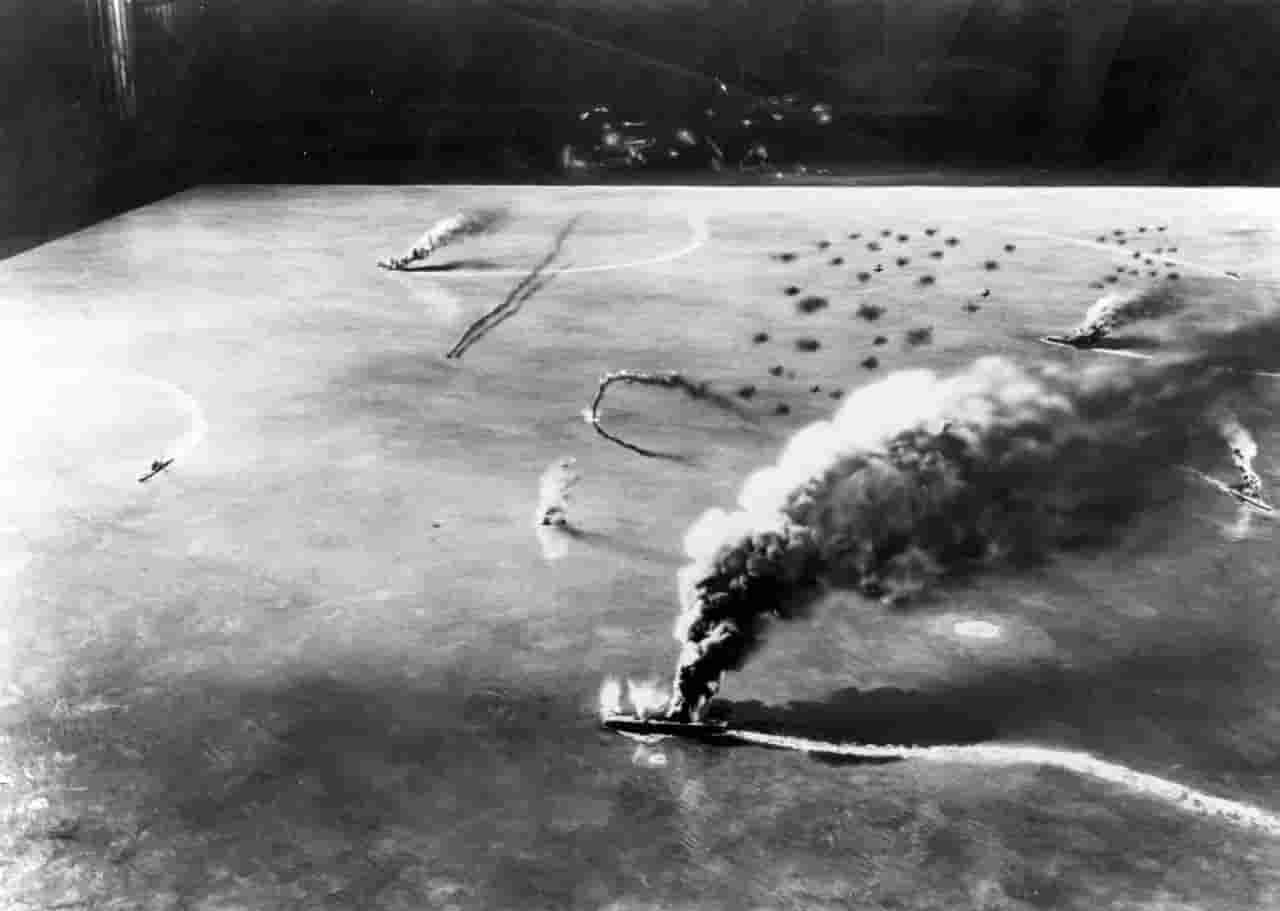
At 10:22, the tide turned. U.S. dive bombers from Enterprise and Yorktown—SBD Dauntlesses led by commanders Richard Best and Max Leslie—arrived over the Japanese fleet at 14,000 feet (4.27 kilometers). The Japanese carriers were at their most vulnerable: flight decks crowded with fueled and armed aircraft, hangar decks packed with bombs and torpedoes, and fighters committed to low-altitude defense. The Enterprise's bombers struck first, hitting Akagi and Kaga with multiple bombs. Fires erupted instantly, spreading through the hangar decks and detonating the munition below. Minutes later, Yorktown's bombers hit Soryu, setting her ablaze as well. Within five minutes, three of Japan's four carriers were doomed.
Afternoon — The Counterstrike and Hiryu's Last Stand
Only one Japanese carrier remained operational: Hiryu, commanded by Rear Admiral Tamon Yamaguchi. At 10:54, Hiryu launched a strike of 18 dive bombers and 6 fighters against the U.S. carriers. At 12:05, they hit Yorktown with three bombs, crippling her. A second strike at 13:30—10 torpedo bombers and 6 fighters—put two torpedoes into Yorktown, leaving her dead in the water. But Hiryu's victory was short-lived. At 17:00, dive bombers from Enterprise found Hiryu and hit her with four bombs. Like her sisters, she erupted in flames. By evening, all four Japanese carriers were burning wrecks.
Evening — The Retreat
By nightfall, Nagumo had no carriers left, and Yamamoto's hopes of saving the operation were fading. Within hours he would call off the invasion—but three more days of fighting lay ahead before the battle was truly finished.
Britannica: Battle of Midway summary and timeline
Wikipedia: Battle of Midway and order of battle
The Second World War.org: Midway battle summary
StationHypo.com: How codebreakers helped secure U.S. victory
National WWII Museum: Battle of Midway articles and casualty figures
Immf-midway.com: Losses in the Battle of Midway (PDF)
U.S. Navy History and Heritage Command: Battle of Midway overview and timeline
Midway. Directed by Roland Emmerich, performances by Ed Skrein, Patrick Wilson, and Woody Harrelson, Lionsgate, 2019.
Intelligence: The Codebreakers' Victory
The single most decisive factor at Midway was intelligence. Without Rochefort's team at Station HYPO, Nimitz would never have known where or when to position his carriers. The ability to read Japanese messages in near real-time gave the Americans a strategic advantage that no amount of firepower could match.
Nagumo's Fatal Delay
Nagumo's decision to rearm his aircraft—from bombs for Midway to torpedoes for ships—cost him precious minutes. During that window, his carriers were packed with fueled planes and live munition, making them floating bombs. When the U.S. dive bombers arrived, the result was catastrophic.
The Sacrifice of the Torpedo Squadrons
The American torpedo squadrons' attacks were tactically disastrous—almost every plane was shot down, and no torpedoes hit. But they drew the Japanese fighters down to sea level, leaving the carriers' upper decks undefended. Without that sacrifice, the dive bombers might never have gotten through.
Yorktown's Resilience
Despite being badly damaged at Coral Sea and rushed into service at Midway, Yorktown absorbed multiple bombs and torpedoes and kept fighting through the morning of 4 June. Her air groups launched strikes that helped cripple Soryu, and her survival into the afternoon pinned down Japanese attention. By around 14:45, after taking two torpedo hits, Yorktown was dead in the water and would soon be abandoned. But her air crews did not go with her: many of the pilots and gunners who had flown off Yorktown landed on Enterprise after their own ship was crippled, and it was these "homeless" Yorktown crews, flying off Enterprise's deck, who helped deliver the late-afternoon strike that finished Hiryu. The ship herself did not launch that final blow—but her people did, and that contribution mattered.
Britannica: Battle of Midway summary and timeline
Wikipedia: Battle of Midway and order of battle
The Second World War.org: Midway battle summary
StationHypo.com: How codebreakers helped secure U.S. victory
National WWII Museum: Battle of Midway articles and casualty figures
Immf-midway.com: Losses in the Battle of Midway (PDF)
U.S. Navy History and Heritage Command: Battle of Midway overview and timeline
Midway. Directed by Roland Emmerich, performances by Ed Skrein, Patrick Wilson, and Woody Harrelson, Lionsgate, 2019.
When the smoke cleared on 7 June 1942, the results were staggering. Japan had lost four fleet carriers, one heavy cruiser (Mikuma), 248 aircraft, and approximately 3,057 men—including many of their most experienced pilots and aircrew. The United States had lost one carrier (Yorktown), one destroyer (Hammann), 150 aircraft, and 307 men. In a single day, the Imperial Japanese Navy had lost the core of its carrier strike force—ships and crews that could not be quickly replaced.
Strategic Consequences
Midway was the turning point of the Pacific War. Before the battle, Japan held the initiative, choosing when and where to strike. After Midway, the two fleets were roughly equal, and the United States soon seized the offensive. The battle ended Japan's ability to launch major strategic offensives in the Pacific. Within two months, U.S. Marines landed on Guadalcanal, beginning a campaign that would push Japan back island by island until surrender.
Recognition and Legacy
Admiral Nimitz later said that the victory at Midway was "essentially a victory of intelligence." Rochefort and his team at Station HYPO received little public recognition at the time—Rochefort was even sidelined after the battle due to internal intelligence politics. Decades later, in 1986, he was posthumously awarded the Distinguished Service Medal and the Presidential Medal of Freedom.
For the men who fought at Midway—on the carriers, on the island, in the cockpits—the battle was a testament to courage, sacrifice, and luck. The dive bomber pilots who struck Akagi, Kaga, and Soryu in those five decisive minutes became legends. The torpedo squadrons, almost entirely wiped out, were remembered as heroes who gave their lives to set up the victory. And the defenders of Midway, who held the atoll against the first Japanese strike, ensured that the island remained in American hands, a base that would support the U.S. advance across the Pacific for the rest of the war.
Britannica: Battle of Midway summary and timeline
Wikipedia: Battle of Midway and order of battle
The Second World War.org: Midway battle summary
StationHypo.com: How codebreakers helped secure U.S. victory
National WWII Museum: Battle of Midway articles and casualty figures
Immf-midway.com: Losses in the Battle of Midway (PDF)
U.S. Navy History and Heritage Command: Battle of Midway overview and timeline
Midway. Directed by Roland Emmerich, performances by Ed Skrein, Patrick Wilson, and Woody Harrelson, Lionsgate, 2019.
1. Japanese Sailors Were Killed Saving Their Ships
Many Japanese casualties were not caused directly by the initial bomb explosions. More than 700 aircraft technicians and maintainers were among the dead, many killed while trying to fight fires, move aircraft, handle ammunition, or keep the damaged carriers operational. Their loss mattered because experienced carrier specialists were exceptionally difficult to replace.
2. The Americans Had No Battleships at the Decisive Moment
The battle was shaped by carriers, aircraft, submarines, and intelligence rather than by a classic line-of-battle engagement. The Japanese had powerful battleships and cruisers farther behind the carrier force, but they never reached the action in time to influence the outcome. Admiral Yamamoto’s main surface force was therefore largely irrelevant to the decisive phase.
3. Yamaguchi Went Down with Hiryū
When American aircraft fatally damaged the Japanese carrier Hiryū, Rear Admiral Tamon Yamaguchi refused to leave. He stayed aboard with the ship’s captain, Tomeo Kaku, and both men went down with the carrier when it sank on 5 June 1942.
Naval History and Heritage Command — Battle of Midway.
Naval History and Heritage Command — H-Gram 006: Midway Overview.
Wikipedia — Tamon Yamaguchi.
Midway. Directed by Roland Emmerich, performances by Ed Skrein, Patrick Wilson, and Woody Harrelson, Lionsgate, 2019.
The Ground
Where it was fought
Test yourself
Quiz
Question 1
What was the Japanese codename for the target Rochefort believed was Midway?
Question 2
What event on April 18, 1942 humiliated the Japanese high command and silenced opposition to Yamamoto's Midway plan?
Question 3
Nagumo ordered his reserve aircraft rearmed from torpedoes to bombs, then back to torpedoes again, wasting critical time.
Question 4
Out of 41 Devastator torpedo bombers that attacked, how many returned?
Question 5
What was the name of the cryptanalysis unit based in a basement at Pearl Harbor?
Question 6
How was Joseph Rochefort treated after the victory at Midway?
Question 7
How many fleet carriers did Japan bring to the Battle of Midway?
Question 8
What was the approximate size of the American garrison stationed on Midway by early June?
Question 9
What was Yamamoto's primary strategic goal at Midway, beyond capturing the atoll?
Question 10
What happened to surviving Yorktown aircrews after their ship was crippled?
Explore more
You Might Also Like
Ranked by country match, then era, then how close the battles were in time.